CPU, DRAM and SSD made up about 68% of a mainstream notebook's build cost in the third quarter of 2026, TrendForce estimated on 8 October. The shelf tag still looks ordinary, which is why each laptop price hike arrives as a surprise and why you, not the maker, pay for it. Waiting does not escape that bill. It adds a monthly charge to it.
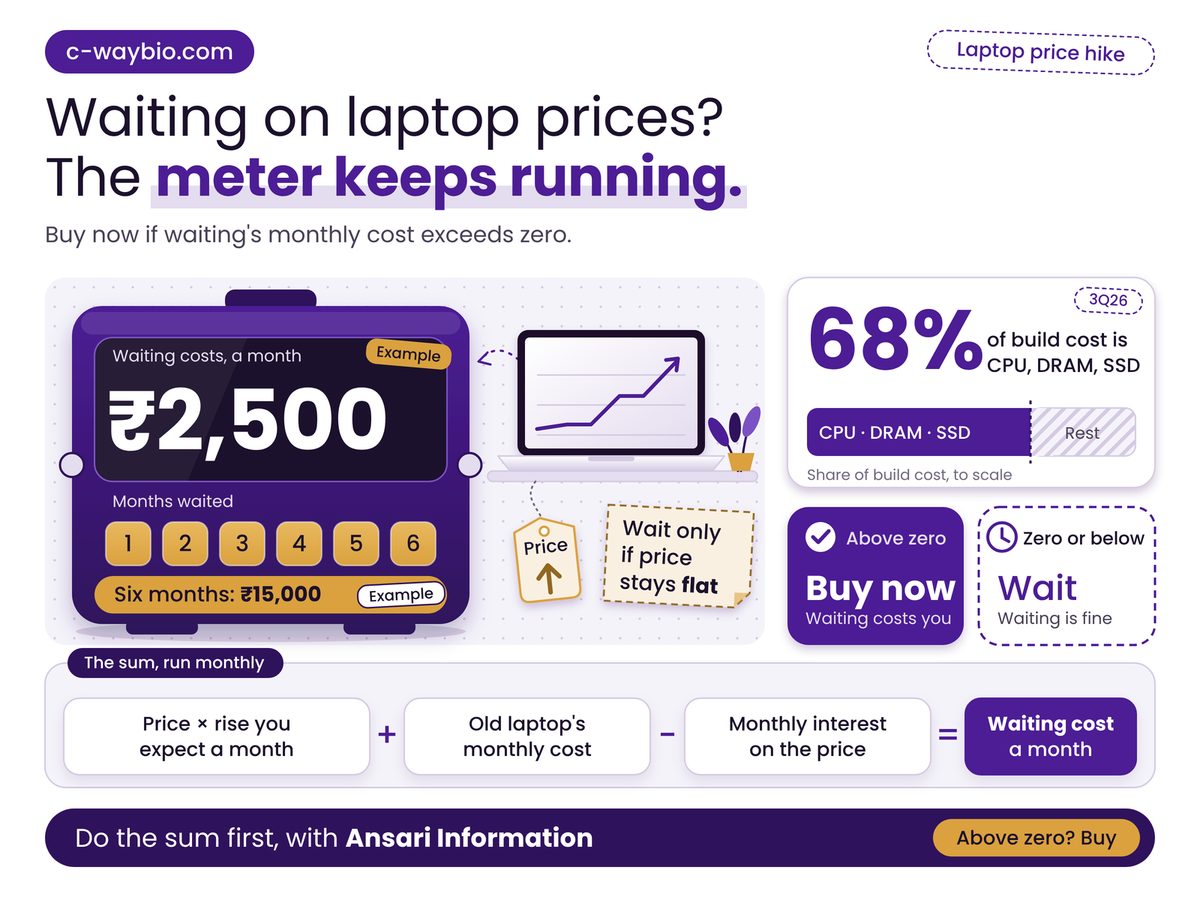
Waiting for a cheaper laptop costs money every month, and the evidence offers no price relief before late 2027.
- The rule: each month of waiting costs your price times the rise you expect, plus your old laptop's monthly cost, minus the interest on the price. Above zero, buy now.
- TrendForce expects DRAM supply to stay tight through 2027, with NAND easing only late in the year.
- The 3% monthly rise in the sum is our assumption from analyst ranges, not a forecast. Change it in the calculator.
Why does a laptop price hike keep outrunning the shelf price?
Brands reprice in steps while component costs move continuously, so each step only catches up with a bill the maker has already paid, and TrendForce says AI server demand keeps DRAM supply tight.
TrendForce's 10 March model shows how far the gap can open. For a notebook with an original MSRP of US$900, it estimated the retail price could rise by nearly 40%. The release names its baseline quarter as 1Q25, so read that as a US scenario, not an Indian price tag. It is a ceiling for the wait, and nothing more.
India has seen steps, not the model. IDC's Navkendar Singh told Digit on 13 March that notebook prices had risen 15% to 17% since December and could climb another 18% to 20%, the range our 3% a month rests on (six months at 3% is 18%). ASUS India's Arnold Su said on 16 April to expect 20% to 30% in the second quarter, a step that adds ₹12,000 to ₹18,000 to a ₹60,000 laptop (our example price). A Vidarbha dealers' association president reported 7% to 10% more from 1 April (a dealer's claim, not independent data). Every range points up.
Four numbers decide how long the squeeze lasts: the memory share of the parts bill, whether cheap chips are caught, when relief could arrive, and whether shoppers walk away. TrendForce's 10 March and 8 October 2026 releases, plus one derivation, supply them.
DRAM + SSD Share of Parts Bill
Over 30%
Double the usual 15% (projected)
Intel Entry-Level CPU Rise
Over 15%
Certain budget chips, not just premium
Wait for Any NAND Relief
7 months
Derived: earliest, DRAM stays tight
Forecast 2027 Shipment Fall
Low single digits
Base case; worse if costs pass on
Start with the time card. It is our derivation: TrendForce says NAND constraints might ease in the second half of 2027, and counting from today to that half's first day gives the months. DRAM has no relief date, since supply is likely to stay tight, so the card is the best case.
Waiting is a bet that prices stop rising, and TrendForce's outlook offers no relief before the second half of 2027. Each month you hold that bet is billed.
Treat waiting like any payback sum, as we did for swapping a window AC for a mini split and AppleCare+ against repair prices (a laptop is not an air conditioner, but the sum has the same shape). The wait is a monthly cost with a break-even.
Worked example: take a ₹60,000 laptop (our example, type your own), a 3% monthly rise (our assumption), a six-month wait, an old laptop that costs ₹1,000 a month in repairs and lost hours (example), and a deposit paying 6% a year (example). Call the result the monthly cost of waiting. Price creep is 60,000 × 3% × 6 = ₹10,800. The old laptop costs 1,000 × 6 = ₹6,000. The interest you keep is 60,000 × 6% ÷ 12 × 6 = ₹1,800. The net cost of waiting is 10,800 + 6,000 minus 1,800 = ₹15,000, or ₹2,500 a month.
What does each month of waiting cost at your numbers?
Find your old laptop's monthly cost down the side, read across at the monthly rise you expect, and the cell is the net rupees each month of waiting costs on a ₹60,000 laptop earning 6% in a deposit.
A negative cell means waiting saves you money, and only one cell in this grid goes there.
| Old laptop costs | 0% rise | 1% rise | 3% rise |
|---|---|---|---|
| ₹0 | -₹300 | ₹300 | ₹1,500 |
| ₹500 | ₹200 | ₹800 | ₹2,000 |
| ₹1,000 | ₹700 | ₹1,300 | ₹2,500 |
| ₹2,000 | ₹1,700 | ₹2,300 | ₹3,500 |
Our arithmetic: the bold cell is the worked example, ₹2,500 a month. One column left it drops to ₹1,300, and one row up it drops to ₹2,000, so your old laptop's cost matters as much as the rise.
Waiting for a sale will not undo a cost share that has climbed to 68% in parts a retailer cannot discount (our reading). Source: TrendForce, 10 March 2026 (45% and 58%, memory plus CPU scenario) and 8 October 2026 (68%, CPU, DRAM and SSD); the measures are not strictly like for like.
Where does the waiting sum go wrong?
It goes wrong when the price you type is not the price you would pay, or when the monthly rise has already stalled by the time you buy.
ASUS India's Su also expects prices to stabilise by the end of the fourth quarter, though not to fall this year. So our 3% a month may be too high from January. Slide it down and waiting gets cheaper, but the old laptop's cost stays, and no relief arrives before late 2027. A flat price is the best case for waiting, not a gain.
Brands can hide a rise inside the spec: Counterpoint Research's Tarun Pathak told Digit they may offer lower configurations instead of big rises. We priced the same hidden drag on an ageing car in the yearly cost of a closed Ford service centre.
- Type the price you would pay after bank offers, not the list price.
- Match the RAM and SSD size exactly, because a cheaper listing may carry less.
- Count the old laptop's real cost: repairs, battery swaps and hours lost to slowness. Zero is rarely honest.
Checks that could change the call
- Your exact RAM and SSD model has an announced sale inside the next month.
- Your old laptop still does your one essential job and has needed no repair this year.
- The brand's own store shows that model cheaper than it was three months ago.
Switch, don't stay. Buy now if the monthly cost of waiting is above zero: your price times the rise you expect, plus your old laptop's monthly cost, minus the interest on the price. Wait only if it is zero or below. The one check: the exact model's price today on your brand's own store, ASUS India's for example, against your retailer's price history. The call is wrong if a dated sale beats the price creep. This week, run your numbers in the calculator above, and if the figure is positive, order before the next step.
How we checked this
Checked: TrendForce's 10 March 2026 and 8 October 2026 releases, IDC's view as quoted by Digit on 13 March 2026, and ASUS India's guidance in Outlook Business on 16 April 2026. Derived: the worked example (₹60,000 laptop, 3% monthly rise, six months, ₹1,000 old-laptop cost, 6% deposit rate) is our assumption set. Not done: no product was tested hands-on for this article, and Indian shelf prices were not surveyed. Last verified: 28 November 2026. Edited by Ansari, reviewed after publication. Spotted something out of date? Tell us and we will correct it.
No comments:
Post a Comment
Note: Only a member of this blog may post a comment.