Thursday, October 22, 2026

Is AppleCare Worth It? One Crack Decides

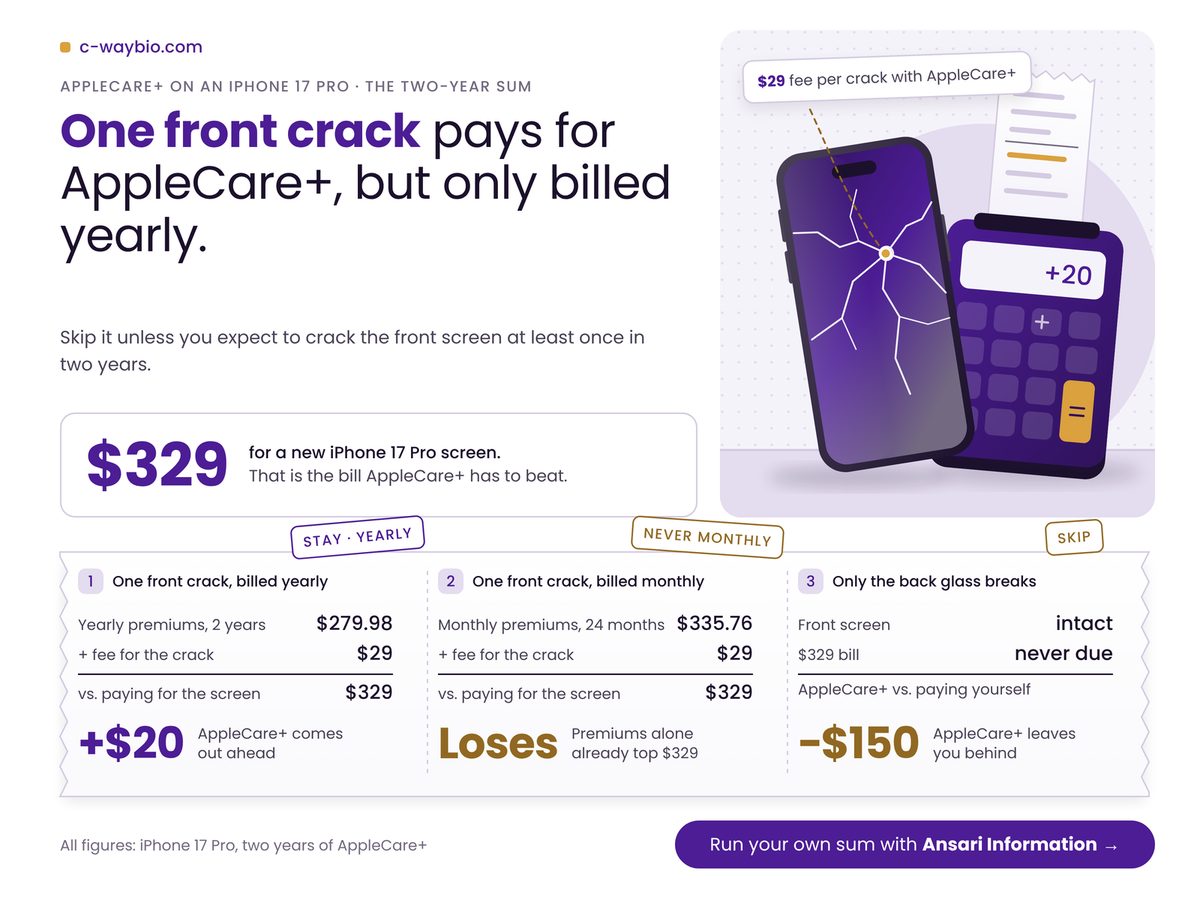
$329. That's what Apple's repair estimator charged for a new front screen on an iPhone 17 Pro, as 9to5Mac reported on 12 September 2025, and the whole question turns on it. So is AppleCare worth it? Add two years of AppleCare+ with Theft and Loss to the fee Apple charges per crack, and set that beside the repair bill. One cracked screen is roughly where the lines cross.
AppleCare worth it math: cracked iPhone beside a calculator and three two-year cost sums

Key Takeaways: skip AppleCare+ on an iPhone 17 Pro unless you expect to crack the front screen at least once in two years, and never pay for it monthly.

  • Billed yearly, one front-screen crack leaves you about $20 ahead after 24 months.
  • Billed monthly, that same crack becomes a loss of about $36.
  • A crack in the back glass alone never repays the plan.
  • Losing the phone is where the cover earns real money.

Is AppleCare worth it if you crack one screen?

Yes, but barely: on yearly billing an iPhone 17 Pro owner who cracks one front screen in two years comes out about $20 ahead, and anyone who cracks nothing has paid $279.98 for reassurance.

Apple Legal's AppleCare fees page, as of October 2026, charges $29 for outer display or back glass damage, and a separate fee applies to each repair. Apple's New York price disclosure for AppleCare+ with Theft and Loss, dated September 2025, lists the iPhone 17 Pro at $13.99 a month, $139.99 a year or $269 for a 24-month fixed term. Same phone, same crack, three different answers.

Worked example: assume an iPhone 17 Pro, AppleCare+ with Theft and Loss billed yearly, 24 months of ownership and one front-screen crack. Premiums are 2 × $139.99 = $279.98. Add the crack fee: $308.98. Without the plan you pay the $329 repair, so the plan wins by $20.02. Billed monthly, premiums become 24 × $13.99 = $335.76; with the fee that's $364.76, and the plan now loses by $35.76.

Twenty dollars is a thin margin for peace of mind. We'd judge it like the payback years on swapping a window AC for a mini split: it earns its place only if payback lands inside the time you own it. Monthly billing is the trap of paying a credit card annual fee to chase its waiver: a cost sliced small stops looking like one.

Four numbers frame every case below. Apple's AppleCare page, read in October 2026, says most Apple products get one year of hardware coverage under the limited warranty, and that plans include unlimited incidents of accidental damage, each with its fee. The fourth card is our own arithmetic.

Free Apple Hardware Cover

12 months

Defects already free in year one

Screen or Back Glass Fee

$29

What each crack still costs you

Accident Claims Allowed

Unlimited

Repeat droppers gain the most

Crack Odds to Break Even

93%

Derived: yearly plan, near-certain crack

The free first year matters: any defect then is Apple's problem anyway, so year-one premiums buy only accident and theft cover.

"

On yearly billing, a 17 Pro owner needs better than nine-in-ten odds of cracking the front glass inside two years before AppleCare+ pays for itself.

That odds figure is one division: $279.98 of premiums over the $300 a crack saves after the fee.

What two years of cover cost, crack by crack

Over 24 months on an iPhone 17 Pro, AppleCare+ only finishes ahead when a front screen breaks, and how you pay moves the result by more than the plan's entire margin on one crack.

Find your row by what breaks in two years, then read across at how you pay. Each cell is what the plan leaves you ahead (+) or behind (−) against Apple's reported repair prices, including $159 for back glass.

What breaks Monthly Yearly Upfront
Nothing −$336 −$280 −$269
Back glass −$206 −$150 −$139
One screen −$36 +$20 +$31
Two screens +$264 +$320 +$331

The shaded cell, one front-screen crack on yearly billing, is the base case at +$20. One column left, monthly, flips it to −$36; one row up, back glass only, drops it to −$150. Now the one-minute check: divide your plan's two-year cost by $300 and compare it with your honest odds of cracking a front screen. Count the screens you broke on your last two phones first.

Month 0 Month 12 Month 22 Month 24 $0 $167.88 $307.78 $335.76 Plan starts Warranty ends Passes the $300 one crack saves Paid before any fee

Pay monthly for a 17 Pro and one front-screen crack stops covering your premiums once you keep the phone 22 months. Derived by summing Apple's $13.99 monthly price against the $300 a crack saves after the fee.

Where the one-crack rule bends

The one-crack rule bends when the phone is lost outright, which the plan covers far more generously than a crack, and when several Apple devices could share one AppleCare One bill.

Apple Legal sets the theft and loss deductible at $149. A new iPhone 17 Pro started at $1,099 in the US, per Apple's September 2025 launch release, so one lost phone saves about $950. On our arithmetic, yearly premiums break even on loss alone if your odds of losing it within two years top roughly 29%. That bar sits far below the crack bar, and we think most buyers undervalue it.

We found no current, method-published US figure for how often owners crack a front screen, so your odds are yours to estimate (the honest grey area here). Weigh them like renewing versus porting a health insurance policy: by what you claimed, not what you fear.

Is AppleCare One cheaper than AppleCare+?

For one iPhone alone, no: AppleCare One Individual costs $19.99 a month for up to three products, so it beats a $13.99 iPhone plan only once a second or third device rides on it.

At $239.88 a year it costs $99.89 more than the yearly iPhone plan, so the extra devices must be ones you'd otherwise insure.

  • Batteries: Apple's battery service page says the plan replaces it free once capacity drops below 80%. The reported $119 out-of-warranty price counts only if yours dips under that line within two years.
  • Monthly billing: 24 payments cost $55.78 more than two yearly ones.
  • Pro Max: its reported $379 screen puts yearly AppleCare+ $70.02 ahead after one crack.

Check each line against your own situation

  • You cracked a front screen on one of your last two phones.
  • You'll keep this iPhone a full 24 months or longer.
  • You can pay yearly, or for the 24-month term, up front.
  • No carrier or card plan already covers phone loss.

Our call: stay uninsured on an iPhone 17 Pro if you can't honestly see a front-screen crack coming within two years, and bank the premium yourself. Switch to AppleCare+, billed yearly, if you can, or if losing a phone is a real risk. This is wrong if Apple has cut its screen price since September 2025, so this week, before you buy, open Apple's repair estimator for your exact model and confirm the screen still costs more than your two-year plan plus the $29 fee.

How we checked this

We read Apple's AppleCare fees and deductibles page and its AppleCare plans page, both checked 23 October 2026, plus Apple's September 2025 price disclosure. Apple's iPhone repair pricing estimator did not load figures for us, so repair prices are 9to5Mac's September 2025 report of it. The worked example assumes an iPhone 17 Pro, yearly billing, 24 months and one front-screen crack. No product was tested hands-on for this article. Last verified: 23 October 2026.

Edited by Ansari, reviewed after publication. Spotted something out of date? Tell us and we will correct it.
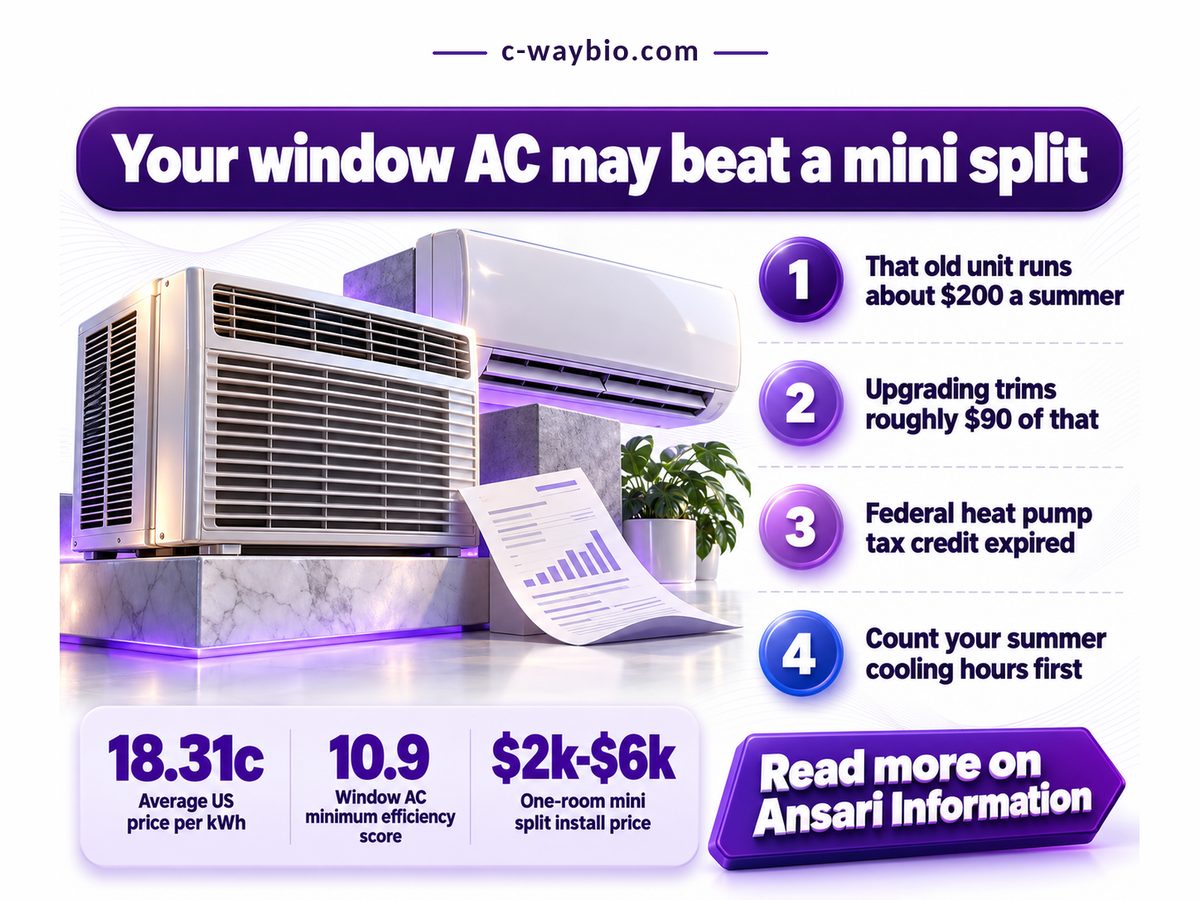
Monday, October 19, 2026

Mini Split vs Window AC: Payback Years

A window unit cooling one room through a 1,000-hour summer burns about $202 of electricity. A mini split doing the same job burns about $110. That $92 gap is the entire case in the mini split vs window ac argument, and it has to repay an install bill of thousands. Here is the sum, line by line, so you can swap in your own numbers.

Infographic of mini split vs window ac running costs beside a power bill

TL;DR: keep a working window unit. Switching saves about $92 a summer, so a $3,000 install needs roughly 33 years to repay itself.

  • Switch only when the window unit is dying, the room needs winter heat, or your building bans window units.
  • Heavier use shortens the wait, but even 1,500 cooling hours a summer leaves about 22 years.
  • The federal heat pump credit has ended, so electricity savings carry the whole sum.

Is a mini split worth it over a window unit?

No, not on cooling savings alone: at the average US residential price of 18.31 cents per kilowatt-hour, a mini split's electricity saving is worth under $8 a month averaged over a year.

That price is the July 2026 residential average in the Energy Information Administration's Electric Power Monthly (released 24 September 2026), up 4.9% on a year earlier. Rising prices favor the mini split, but 4.9% of a $92 saving is under $5 a year, so the trend will not rescue the payback.

Three assumptions, all mine: a 12,000 BTU/h (one-ton) unit running 1,000 full-load hours a summer, and a $3,000 install, inside the $2,000 to $6,000 Filterbuy's 2026 cost guide gives for one room (Carrier quotes $2,000 to $10,500 for 1,000 square feet).

  • Window unit: the Department of Energy's floor for a louvered unit this size, built since 2014, is 10.9 CEER, a combined efficiency score in BTU of cooling per watt-hour. 12,000 ÷ 10.9 is about 1,101 watts, so 1,101 kWh over the summer, times 18.31 cents, is $202.
  • Mini split: assume 20 SEER2, a seasonal score of the same kind. 12,000 ÷ 20 is 600 watts, so 600 kWh, which is $110. Carrier's single-zone line lists top ratings from 22.4 to 35.1 SEER2, so 20 is not a stretch.
  • The gap: 501 kWh, or $92 a summer.

One caution: SEER2 averages a mild season while CEER is a single hot-day test, so the comparison tilts a little toward the mini split (I would rather say so than flatter the upgrade). We ran the same kWh-first method in rupees in our piece on pricing an AC by kWh instead of stars.

Four numbers decide the swap, and read together they turn a $92 headline into a decision.

Payback on a $3,000 install

33 years

Longer than a 30-year mortgage

Saving per month, averaged

$7.65

Lost inside an ordinary bill

Yearly saving for 10-year payback

1,638 kWh

Over triple what you save

Cooling electricity cut

46%

Real saving, small dollars

Take the yearly saving a ten-year payback demands. At the 501-watt gap between the two machines, reaching it would take about 3,270 full-load hours in a summer, which is 136 days of nonstop cooling. That is my arithmetic, not a published figure, and no ordinary room comes close.

"

Nearly half the electricity gone and still decades to repay: that is the whole case for keeping a working window unit.

A certain saving set against an upfront cost is a familiar shape: see a home loan prepayment against a SIP at the break-even rate.

Mini split vs window ac: the decision table

Stay with the window unit if it still works, and switch only when one of four conditions applies; the table prices each side so you can see which way every row pushes.

Read the left column first. A tick favors the swap, a warning sign means it depends on your home, and a cross counts against it.

Dimension Mini split vs window unit What it means for you
💰 Install price Mini split $3,000 assumed
Window $0 if it works
❌ The whole install is your cost
💰 Summer power Mini split $110
Window $202
✅ Real saving, small in dollars
⏱ Payback range 600 hours 55 years
1,500 hours 22 years
❌ Even heavy use repays slowly
📊 Efficiency Mini split 20 SEER2
Window 10.9 CEER
⚠️ Different tests flatter the mini split
🔋 Winter heat Mini split Heats and cools
Window Cooling only, usually
⚠️ Matters if you heat that room
🛠 Setup Mini split Wall hole, outdoor unit
Window Sits in an open sash
⚠️ Rentals and HOAs may block it
🏁 Best suited for Mini split Dead unit, needs winter heat
Window Working unit, cooling only
🏁 Stay put unless a condition applies

Only one row clearly favors the mini split, and it is about running it, not buying it.

73%. is the install. Install $3,000. Power $1,099. Ten-year cost, one room.

Nearly three-quarters of what a mini split costs over ten years is the install, so the power bill never decides the payback. Derived from $3,000 up front plus ten summers at $110: my arithmetic, not a published figure.

What breaks the payback sum?

Cheaper power or fewer cooling hours stretch payback toward half a century, while a dead window unit or a winter heating need shrinks the gap the install has to repay.

At 12 cents a kWh, an assumption of mine, the $3,000 takes about 50 years; at 25 cents, about 24. Buying down does not help: the federal floor for heat pumps since 2023 is 14.3 SEER2, per Carrier's summary of the Department of Energy rule. A unit at that floor saves only $48 a summer against the window unit, so payback passes 60 years.

Tax credits used to bend this sum. The IRS page for the Energy Efficient Home Improvement Credit (last reviewed 28 April 2026) allows up to $2,000 a year for heat pumps, but only for property placed in service through 31 December 2025, so a 2026 install gets nothing. Whether your utility or state still pays a rebate is the open question, and my view is that a rebate you cannot see in writing is not a number.

  • Get quotes with any rebate printed on them.
  • Read the rated SEER2 on the exact model; the 20 here is an assumption.
  • Count your real cooling hours: a room cooled only on summer evenings sits far below 1,000.
  • If the window unit is dying, price its replacement and subtract it, because only the difference needs repaying, the same sunk-cost move as in paying a card annual fee instead of chasing its waiver.

Check these four conditions before you ask for a quote

  • Your window unit has died, or you expect this summer to be its last.
  • You heat this room in winter with a space heater or electric baseboard.
  • Your lease, building or HOA bans window units, or the sash will not open.
  • You run cooling around the clock for months, well past the top row of the table.

Stay with the window unit. Unless it is dying, the room needs winter heat, your building bans window units, or you cool around the clock for months, the swap is a 30-year bet at best. This week, pull last summer's electric bills, estimate your cooling hours honestly, and re-run the sum above with your own price per kWh before anyone hands you a quote.

Tuesday, October 13, 2026

Proportionate Deduction on a ₹8,000 Room

₹64,500. That is what four nights in an ₹8,000 room instead of a ₹5,000 one cost once the insurer applies proportionate deduction to a ₹3 lakh bill, more than five times the extra rent. The policy is ordinary: ₹5 lakh cover, room rent capped at 1%. Nobody quotes the number at admission. You meet it at discharge.

Infographic on proportionate deduction showing a hospital room, an itemised bill and claim figures

Key Takeaways

On a ₹5 lakh policy with a 1% room cap, an ₹8,000 room turns ₹12,000 of extra rent into a ₹64,500 hole in a ₹3 lakh claim.

  • Surgeon, theatre, nursing and visit fees are paid at the room's 62.5% ratio.
  • IRDAI rules exempt pharmacy, implants, diagnostics and ICU charges, so a cut there is challengeable.
  • Stay in the capped room; switch at renewal only if a no-cap plan costs under ₹6,450 a year more.

What is proportionate deduction in health insurance?

It is the insurer's rule that if your room costs more than the policy's daily room cap, every charge linked to that room is paid only in the same ratio as the cap bears to your room rent.

Outlook Money's August 2026 explainer gives the logic: hospitals price surgeon fees, theatre time and nursing by room category, so a dearer room implies dearer everything. Caps are a fixed rupee figure or a share of sum insured, commonly 1%, which on ₹5 lakh puts the line at ₹5,000 a night.

The whole sum, four nights, ₹3,00,000 billed, eligible ratio 5,000 ÷ 8,000 = 62.5%:

  • Room rent: 4 x ₹8,000 = ₹32,000 billed, ₹20,000 paid, ₹12,000 cut.
  • Linked charges (surgeon, theatre, nursing, doctor visits): ₹1,40,000 billed x 62.5% = ₹87,500 paid, ₹52,500 cut.
  • Exempt heads (pharmacy, implants, diagnostics): ₹1,10,000 billed and paid in full.
  • Items the policy lists as non-payable: ₹18,000 billed, nothing paid.

Your share: ₹82,500. Remove the ₹18,000 you would lose in any room and ₹64,500 is the upgrade's price, my arithmetic on an illustrative bill, not an insurer's quote. Every extra rupee of rent cost about ₹5.38, or, put less politely, the upgrade was the dearest thing in the building.

This is not an edge case. IRDAI's 2024-25 annual report, per Insurance Business in July 2026, counts 3.26 crore health claims with 8% repudiated outright, and partial cuts like this sit on top, uncounted. No insurer-wise denial reasons are published, so you must run the sum from your own schedule. Deciding whether to renew or port your health insurance? Read the room cap line first. If your share would come from savings, the FD versus debt fund gap on ₹5 lakh shows what that money earns meanwhile.

I don't object to the cap. I object to the timing: the insurer knows the ratio when it approves admission and should print your payable share on that approval. The four numbers below come from IRDAI's May 2024 Master Circular, Outlook Money, and the 2024-25 IRDAI and Ombudsman reports via Insurance Business.

Cashless Decision Deadline

1 hour

Ask for the payable figure early

Room Cap on ₹5 Lakh Cover

₹5,000/day

Any dearer room triggers cuts

Insurance Grievances, FY25

2,57,790

Disputed claims are routine

Ombudsman Cases Won by Policyholders

~71%

Escalating usually pays off

The deadline is the one to use. The admission-day authorisation carries an approved amount and an assumed room category; ask for it in writing. If it names a cheaper category than your bed, the ratio is running, and you can still move before the first night is billed.

"

A wrongful room-ratio cut costs nothing to escalate, and the Ombudsman sides with the policyholder in most cases it hears. That beats arguing at the billing counter.

Capped room or upgrade: which leaves you paying less?

The capped ₹5,000 room leaves you paying only the ₹18,000 of non-payable items, while the ₹8,000 room adds ₹64,500 of ratio cuts, so on this bill the upgrade costs more than five times its extra rent.

The table runs both rooms against one illness, with linked fees billed identically. A cheaper room often lowers them too, which changes the insurer's share, not yours.

Dimension ₹5,000 room vs ₹8,000 room What it means for you
💰 Room rent ₹5,000 room ₹20,000, all paid
₹8,000 room ₹32,000, ₹20,000 paid
❌ The rent above the cap is yours
🧾 Linked fees ₹5,000 room paid in full
₹8,000 room ₹87,500 of ₹1,40,000
❌ Surgeon and nursing fees shrink too
📊 Drugs and tests Both rooms ₹1,10,000, paid in full ✅ Exempt heads stay whole either way
⚖️ ICU days Both rooms no ratio allowed on ICU ✅ Challenge any ICU deduction
⏱ Discharge delay Both rooms insurer pays past 3 hours ✅ A paperwork night is not your bill
🛠 Non-payables Both rooms ₹18,000, none paid ⚠️ Same loss whichever bed you take
💰 Your share ₹5,000 room ₹18,000
₹8,000 room ₹82,500
❌ The upgrade costs over 5x its rent
🏁 Best suited for ₹5,000 room anyone with a room cap
₹8,000 room plans with no cap
🏁 Upgrade only if the cap is gone

One row does the damage: linked fees, where the ratio bites on a base over four times the rent itself.

Where a ₹3,00,000 bill goes on an ₹8,000 room. Insurer pays ₹2,17,500 · 72.5%. Lost to the room ratio · 21.5%. Never covered in any room · 6%.

The bar settles whether the upgrade pays on a capped policy: over a fifth of the bill vanishes to the ratio, three times the never-covered share. Derived from this article's illustrative bill.

How do I avoid a room rent cut on my claim?

Pick a room at or below your policy's daily cap, or hold a plan with no room cap at all; beyond that, check every line of the deduction letter, because several heads are legally off-limits.

IRDAI's June 2020 product-filing guidelines, reported by Business Standard, bar the ratio on ICU charges, pharmacy, implants, medical devices and diagnostics, and at hospitals that do not bill by room category (as of 2020). Under the May 2024 Master Circular, charges from a late discharge approval fall on the insurer, Deccan Chronicle reported.

Still cut? Complain to the insurer, then the Insurance Ombudsman. Its 2024-25 report counts 53,184 complaints, about 64% of them health, so your dispute is its main business.

My view on the grey area: when no room within your cap is free the night you arrive, the ratio should not apply. Argue it in writing. The break-even logic for home loan prepayment against a SIP works here too.

  • A cap written as a rupee figure does not rise when you raise your sum insured.
  • A cap named as a room type still bites if you move up a category.
  • A deduction on ICU days, pharmacy, implants or diagnostics is challengeable line by line.

Before you accept the upgrade, check all four:

  • Your policy schedule shows a room cap, as a rupee figure or a share of sum insured.
  • The room you are offered costs more per day than that cap.
  • The hospital's tariff prices surgeon or nursing fees by room category.
  • No room-cap waiver or add-on is in force on your plan.

Stay in the capped room: on this bill the upgrade buys four nights of comfort for ₹64,500. Switch at renewal only if a no-cap plan costs under ₹6,450 a year more, my ten-year break-even against one such claim. This week, find the room rent line in your policy schedule and write its daily rupee figure on your health card.

Thursday, October 8, 2026

Home Loan Prepayment vs SIP: Break-Even

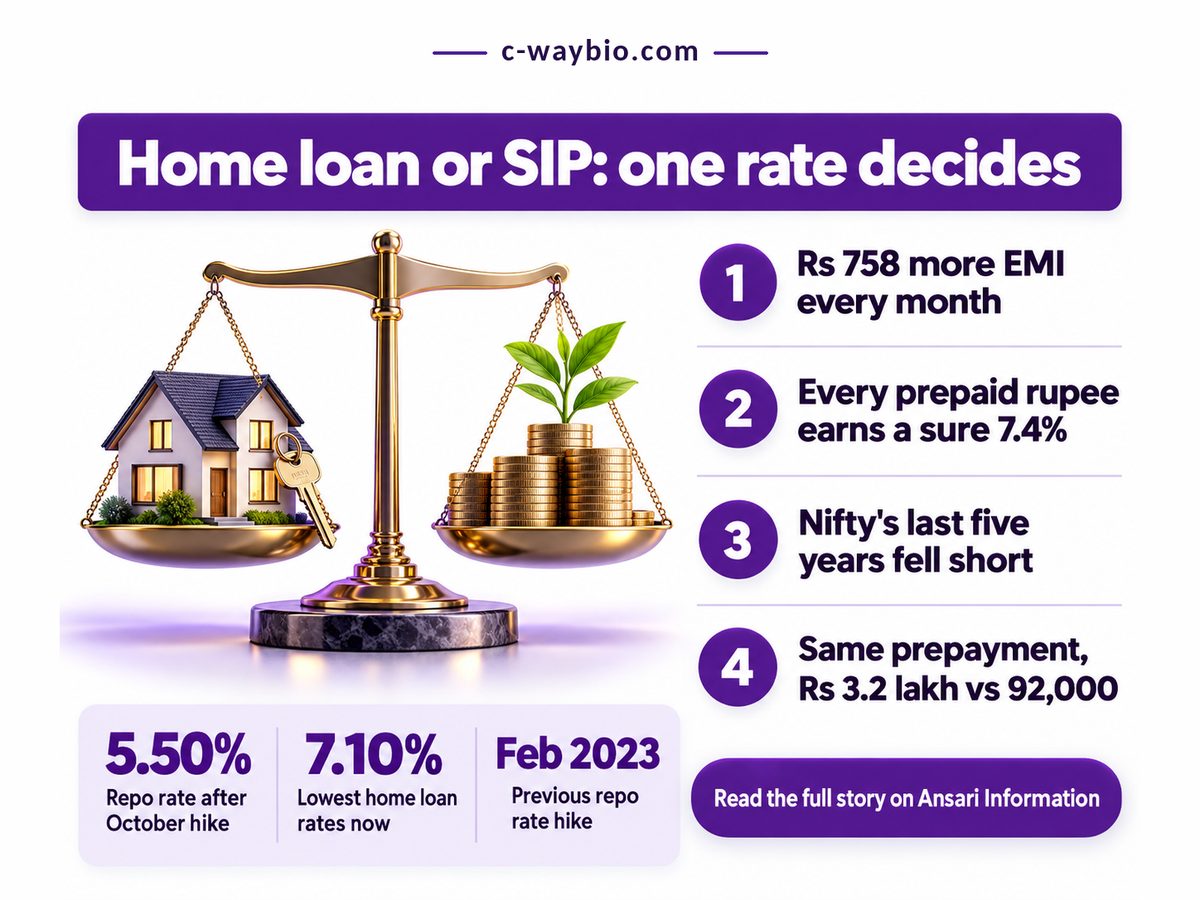
₹758 a month. That is what Wednesday's repo hike adds to a ₹50 lakh, 20-year home loan as its rate moves from 7.15% to 7.40%, taking the EMI from ₹39,216 to ₹39,974 in Paisabazaar's worked example. Call it ₹9,100 a year, or a longer loan if your bank stretches the tenure instead. If you also run a monthly SIP, the hike reopens home loan prepayment vs SIP, and this time the sum is closer than the usual advice admits.

Infographic on home loan prepayment vs SIP with a balance scale, house and coins

Key Takeaways

Prepay if your SIP can't reliably beat about 7.7% to 8% a year before tax; keep the SIP if you have 15 years or more and a full emergency fund.

  • A prepaid rupee earns your loan rate, tax-free and riskless.
  • Nifty 50's last five years returned less than a 7.4% loan costs.
  • Ask the bank to cut the tenure, not the EMI: the interest saved is about 3.5 times larger.
  • Old-regime filers lose no deduction by prepaying while yearly interest stays above the cap.

Why the repo hike reprices home loan prepayment vs SIP

Because a prepaid rupee earns exactly your loan's interest rate with no risk, every repo hike raises the return on prepaying, and it lifts the after-tax return a SIP must beat by the same amount.

The Reserve Bank of India raised the repo rate by 25 basis points to 5.50% on 7 October 2026, its first increase since February 2023, according to Paisabazaar. Floating home loans reprice at their next reset, so the guaranteed return on prepaying climbs while your SIP's expected return stands still.

The other side is less comfortable. NSE Indices' Nifty 50 factsheet, dated 30 September 2026, shows the index's total return (dividends reinvested) compounding at 6.38% a year over five years. An index SIP over that stretch earned less than your loan now costs. Since launch the index has compounded at 12.12%, the number every "invest, don't prepay" argument leans on, but that describes a 15-year-plus holding.

Tax widens the gap. Equity gains held over a year are taxed at 12.5%, so the SIP has to earn more than the loan rate just to tie, while the interest you avoid by prepaying is never taxed. Paisabazaar lists home loans from 7.10%, so even the best-priced borrower earns at least that, risk-free, on each prepaid rupee. Same discipline as the post-tax gap between an FD and a debt fund: compare what lands in your hand, not the headline rate. It is the sure-saving-versus-hoped-for-gain trade from credit card annual fee waivers, with bigger numbers.

Our own working on that example loan, with ₹1 lakh prepaid at the reset, gives the four numbers that decide this.

Loan Shortened by ₹1 Lakh

10 months

Debt-free that much sooner

Interest Saved by That Lakh

₹3.24 lakh

Over three times the payment

Year-One Interest on ₹50 Lakh

₹3.66 lakh

Far above the deduction cap

Old-Regime Loan Cost, 30% Slab

5.2%

Only once interest is capped

That interest figure assumes you tell the bank to keep the EMI and shorten the loan. Ask for a lower EMI instead and the same lakh saves only about ₹91,900, because the bank re-spreads your balance over the full remaining term. The EMI falls by roughly ₹800, which helps only if you invest it, monthly, above the loan rate. Most people don't.

"

One lakh prepaid buys back ten months of EMIs. No SIP will put a guarantee like that in writing.

So it turns on one question: what return can you honestly expect, after tax, over the years your loan has left?

Is it better to prepay a home loan or invest in a SIP?

Prepaying is better unless you can reasonably expect your SIP to earn more than about 7.7% to 8% a year before tax, over 15 years or more, with an emergency fund already in place.

Dimension Prepay vs SIP What it means for you
💰 What you earn Prepay Your loan rate, 7.4% now
SIP Market-linked, never fixed
⚠️ You trade certainty for a bigger maybe
🧾 Tax on gains Prepay Nothing on interest saved
SIP First ₹1.25 lakh/yr tax-free
✅ Modest SIPs feel little tax drag
⏱ Time needed Prepay Works from the next EMI
SIP 15+ years for long-run pace
⚠️ Under 15 years, equity is a coin toss
📊 Bar to clear Prepay Rises with every repo hike
SIP 7.7% to 8% a year pre-tax
⚠️ Test your fund's 10-year record against it
⚖️ Old tax regime Prepay Full rate until year 14
SIP Taxed the same either way
✅ Early prepaying costs no deduction
🔒 Cash access Prepay Locked until loan closes
SIP Sell on any trading day
❌ Prepaid money can't pay a hospital bill
🛠 How to apply it Prepay Cut tenure, keep the EMI
SIP Same date, every month
✅ Tenure cuts save 3.5 times the interest
🏁 Best suited for Prepay New regime, under 15 years
SIP 15+ years, cash buffer full
🏁 Can't count on 8%? Prepay

Read the right-hand column: the SIP wins only on time. Without a long horizon and a cash buffer, the loan wins.

₹4.17 lakh. Prepaid, so it earns 7.4%. Guaranteed, tax-free. ₹3.30 lakh. SIP at Nifty's recent. five-year pace, after tax. ₹8.90 lakh. SIP at Nifty's long-run. pace, after tax. 7.7% a year. SIP return that only ties. the prepayment, before tax.

If your SIP cannot reliably earn about 7.7% a year before tax for 20 years, the lakh belongs in the loan. Our derivation: ₹1 lakh compounded 20 years at each rate, after capital gains tax, on NSE Indices data.

When should you not prepay a home loan?

Skip the prepayment if it would drain your emergency fund, or if you file under the old tax regime and your yearly interest has already fallen below the deduction cap; in both cases the SIP keeps the edge.

Old-regime filers can deduct up to ₹2 lakh a year of interest on a self-occupied home, per the Income Tax Department; the new regime allows nothing. On this loan that changes little, at least not yet: yearly interest stays above the cap until year 14, so early prepayment cuts interest you were never deducting.

Liquidity is the harder limit. If a hospital bill would push you onto a credit card, fix that first, starting with whether to renew or port your health insurance. Honestly, a family with thin cover shouldn't run this sum yet.

  • Penalty: RBI's Pre-payment Charges on Loans Directions, 2025 bar charges on personal floating-rate loans sanctioned or renewed from 1 January 2026, so part-payments cost nothing extra.
  • Next hike: SBI Research forecasts another 25 basis points in December 2026; that would lift this loan's bar to about 7.65%.

Prepay this month only if all of these hold:

  • Your lender's next reset carries a rate of 7.4% or higher.
  • Six months of expenses already sit in a liquid fund.
  • New regime, or yearly interest still above the old-regime cap.
  • You might need this money within 15 years.

Any line fails: keep the SIP and revisit at the next reset.

Stay or switch? Stay with the SIP if you have 15 years to run, a full emergency fund and the stomach for another five years like the last. Otherwise, switch. This week, find your next reset date and rate in your lender's portal, and if the card says prepay, send ₹1 lakh with a written request to cut the tenure, not the EMI.

Sunday, October 4, 2026

Credit Card Annual Fee Waiver vs Paying

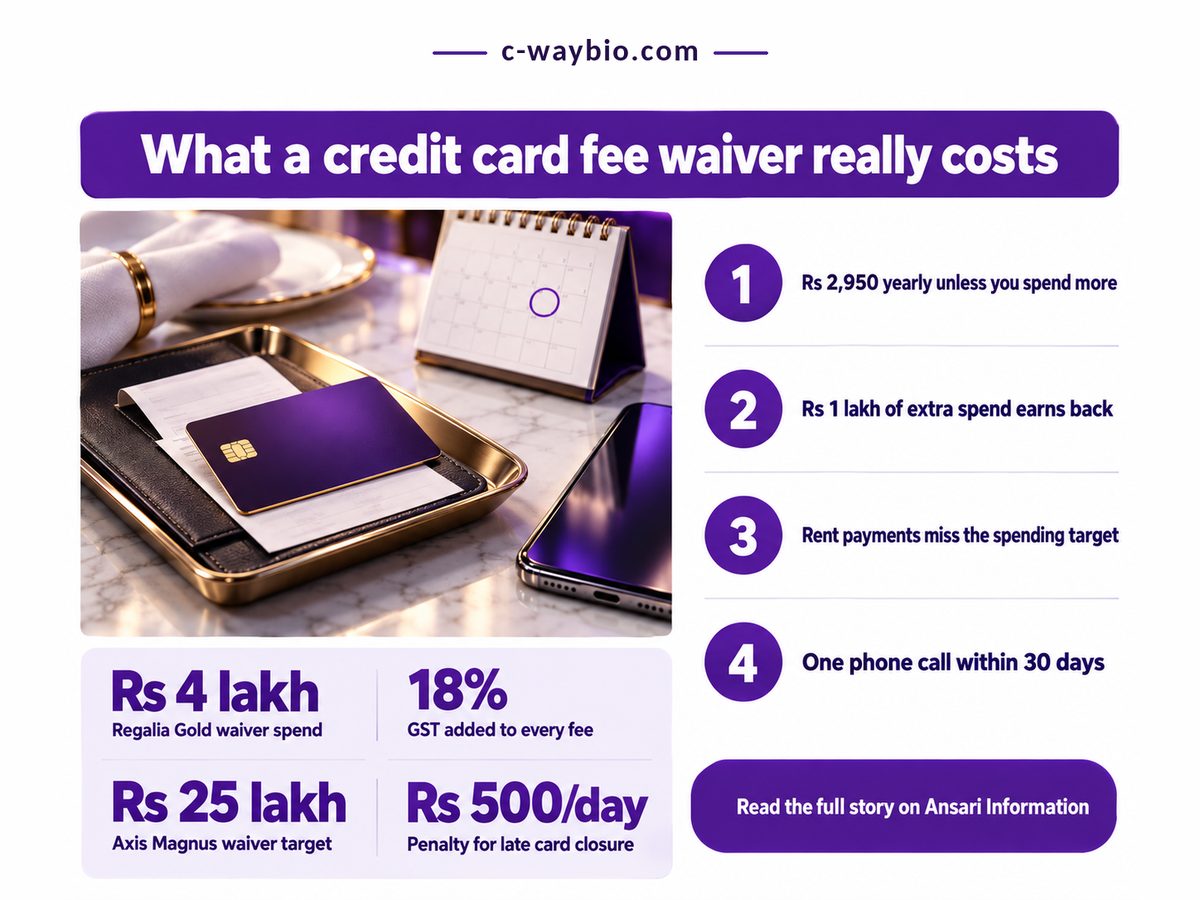
₹2,950. That charge lands on an HDFC Regalia Gold statement on the card's anniversary unless ₹4 lakh went through the card in the year before, per cardadvisor.in's Regalia Gold page (updated 1 October 2026). Divide one by the other and the credit card annual fee waiver is worth 0.74% of the spending it asks for. The SMS saying you're short feels like a deadline. The arithmetic decides whether it is one.

Credit card annual fee waiver infographic with a card, bill tray and calendar

Key Takeaways: chase the waiver only with bills you already pay; otherwise pay the fee if you use the perks, or downgrade to a no-fee card.

  • Treat a waiver as a discount of 1% or less on extra spending.
  • Moving real bills wins unless the card they leave returns over about 3.3%.
  • Rent, wallet loads and gaming do not count on Regalia Gold.
  • If the fee posts, dispute it early; close if refused.

What is a credit card annual fee waiver really worth?

A waiver is worth the fee divided by the spend target, which on five popular Indian cards works out to between 0.30% and 1.18% of the money you must put through the card.

The rest of the sum, GST included, from cardadvisor.in's fee-waiver guide (updated 10 August 2026). Check each against your bank's MITC, the binding fee schedule.

  • HDFC Millennia: ₹1,180 waived at ₹1 lakh of spend, so 1.18%.
  • HSBC TravelOne: ₹5,899 waived at ₹8 lakh, so 0.74%.
  • SBI Card Elite: ₹5,899 waived at ₹10 lakh, so 0.59%.
  • Axis Bank Airtel: ₹590 waived at ₹2 lakh, so 0.30%.

Now the other half. Since 15 May 2026, Regalia Gold earns 5 reward points per ₹200, down from 4 per ₹150; a point fetches ₹0.15 to ₹0.20 as statement credit or ₹0.50 on SmartBuy flights. Say you are ₹1 lakh short with a month to go. Closing the gap earns 2,500 points, worth ₹375 to ₹1,250. Add the fee you keep and the move is worth ₹3,325 to ₹4,200, or it would be, if that lakh is money you were spending anyway. As with the post-tax gap between an FD and a debt fund, the headline number is not the one you keep.

This site's line, from its own sum: if the lakh comes off UPI or a debit card, chase every time. If it comes off another credit card, chasing still wins unless that card returns more than about 3.3%, where its lost rewards eat the ₹3,325 floor. If it is shopping you would not otherwise do, you have spent a lakh to save about 3% of it. "Just hit the target" is backwards advice for anyone buying things to get there.

Four more numbers decide whether that sum is open to you at all. GST inflates every quoted fee, much as it once shaped whether to renew or port a health policy.

TravelOne Counting Switch

July 2026

Card year, not 1 April

GST on a ₹4,999 Fee

₹900

May stay after a reversal

Axis Magnus Waiver Target

₹25 lakh

Twelve big months, every year

GST on Every Annual Fee

18%

Quoted fees understate the bill

The counting switch bites hardest. A TravelOne holder tracking from the financial year's start is measuring the wrong twelve months, and a gap that looked comfortable can close weeks early.

"

Axis Magnus wants ₹25 lakh a year before it forgives its fee. That is not a target most households can reach with bills they already pay.

Is it worth paying a credit card annual fee?

Paying is worth it only when the perks you actually used this year, lounge visits or milestone vouchers, are worth more than the fee; chasing wins when eligible bills can close the gap.

Dimension Chase vs Pay What it means for you
💰 Net this year Chase Up to ₹4,200 ahead
Pay Fee gone, perks kept
✅ Moved bills make the waiver pay
📊 Points on gap Chase 2,500 on ₹1 lakh
Pay Only on usual spend
⚠️ Redeem on flights, not as cash
🧾 Eligible spend Chase Rent, wallets, gaming out
Pay Nothing to track
❌ Rent cannot buy this waiver
⏱ Counting window Chase Card year, not April
Pay Fee hits on anniversary
⚠️ Count from your card's start month
🔋 Big targets Chase Magnus: ₹2.08 lakh a month
Pay ₹14,750 a year
❌ Few homes can move that much
⚖️ Fee rise Chase 30 days' notice first
Pay Exit without charge
✅ A higher target is your exit door
🏁 Best suited for Chase Gaps you fill with bills
Pay Perks worth over the fee
🏁 Neither? Downgrade to a no-fee card

If neither column fits your year, ask for a product change to a no-fee card before the anniversary; a downgrade usually keeps your credit line and history, which closing does not. The fee-rise row rests on the RBI's Master Direction on Credit and Debit Cards (clauses 24(c) and 30).

1. 2. 3. 4. 5. Day 0. Fee posts. By day 30. Call for reversal. Refused? Ask to close. 7 working days. Card must close. After that. ₹500 a day to you.

If the waiver is out of reach, this settles when to act: dispute the fee inside the first month, and if refused, close before the next fee with the regulator's clock on your side. Source: RBI Master Direction, clause 8(a), and cardadvisor.in's fee-waiver guide for the call window.

Does rent count towards the annual fee waiver?

No, not on Regalia Gold: rent, wallet loads, online gaming, third-party education payments and utility bills beyond ₹50,000 are excluded from the spend that earns the waiver, and insurance counts only up to a cap.

That kills the popular shortcut of routing rent through a payment app. The honest route is spending you now make from a bank account, such as groceries and pharmacy bills; first check who actually pays UPI transaction charges. Pulling forward a purchase already decided, like a phone upgrade timed around smartphone launch prices in India, is fine. Inventing one is not.

Can I close my credit card to avoid the annual fee?

Yes, and once dues are cleared the RBI's Master Direction on Credit and Debit Cards obliges the bank to close the card within the deadline shown above, or pay you a penalty for each day of delay.

Should you? Closing is the blunt tool; a downgrade is sharper. One grey area remains, and this is opinion: whether a bank may keep the GST on a fee it reversed. The RBI bars undisclosed charges, but MITC wording decides the tax.

  • A reversal needs your spend records; GST returns only if the MITC says "annual fee including applicable GST".
  • Add-on spend counts only where the MITC says "total eligible spend across primary and add-on cards", letting a spouse's groceries close the gap.
  • Your spreadsheet may count from 1 April; the bank may count from the anniversary.

Check these before your card anniversary

  • Bills you already pay from a bank account can fill the gap.
  • None of them is rent, a wallet top-up or gaming.
  • No other card you hold returns over about 3.3% on them.
  • Perks you used this year beat the fee.

Stay or switch? Stay and chase if the first three boxes are ticked. Stay and pay if only the fourth is. Tick none and switch: ask for a downgrade to a no-fee card, and close only if the bank refuses. This week, open your card's MITC, find the waiver clause and anniversary date, and total your eligible spend since then.

Tuesday, September 22, 2026

FD vs Debt Fund: The Tax Gap on ₹5 Lakh

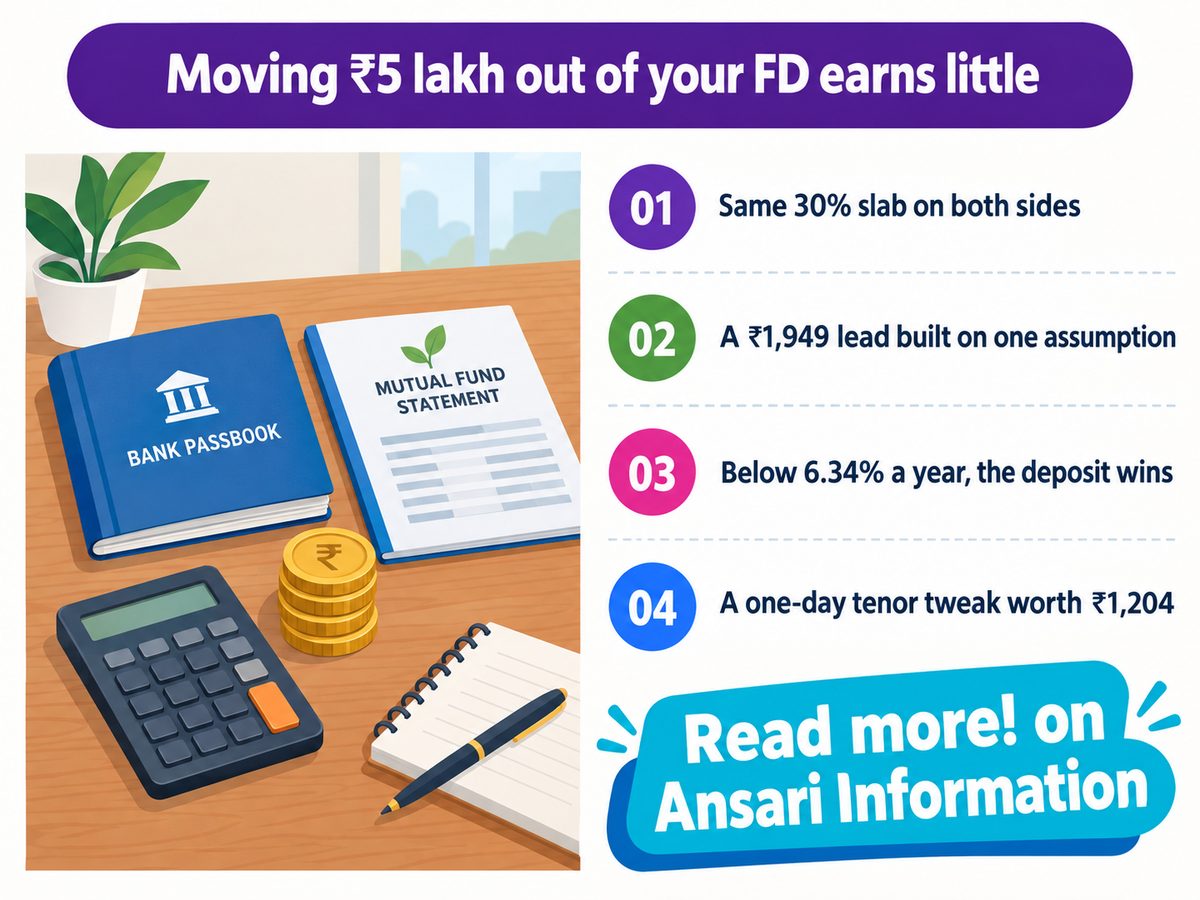
₹1,949. That is the entire prize for moving ₹5 lakh out of a three-year SBI fixed deposit into a debt fund, at the 30% slab, if the fund behaves. A cousin calls debt funds "more tax-efficient", and you are one click from breaking a deposit. Run the fd vs debt fund sum first. A phone calculator can check it.

Passbook, fund statement and calculator weighing fd vs debt fund on ₹5 lakh

TL;DR: At the 30% slab with ₹5 lakh for three years, stay in the FD. The debt fund leads by under ₹2,000, on an assumed yield.

  • Debt fund units bought since April 2023 are taxed at your slab, exactly like FD interest.
  • The fund's only structural edge is paying tax once, at exit.
  • A fund netting less than 6.34% a year loses to a 6.30% three-year FD.
  • Senior citizens should not switch: SBI's senior rate wins outright.

Are debt funds better than FDs after the 2023 tax change?

Not for most savers, because gains on debt fund units bought since April 2023 are taxed at your income slab, so the old tax-rate advantage has gone and only the timing of the tax bill still differs.

ClearTax's summary is blunt: units bought on or after 1 April 2023 count as short-term whatever the holding period, taxed at slab, no indexation. At 30%, the government takes the same share from either product, so the choice turns on when you pay. It is the discipline behind deciding whether to renew or port a health policy after the GST exemption: strip the label, price the rupees.

Here is the whole sum, before cess. SBI's card, tabulated by GoldenPi for September 2026, pays 6.30% on three-to-five-year deposits; quarterly compounding makes that 6.45% a year. Banks count interest as it is credited, so the FD's tax comes out yearly. The fund's 6.5% net yield is an assumption, a planning number for a short duration debt fund, not a promise.

  • FD: ₹1,01,190 of interest over three years, taxed each year at 30%, costs ₹30,357. You keep ₹5,70,833.
  • Debt fund: ₹5,00,000 grows to ₹6,03,975. Tax at exit on the ₹1,03,975 gain is ₹31,192. You keep ₹5,72,782.
  • Gap: ₹1,949 to the fund, roughly ₹54 a month for carrying market risk.

Split the gap, because its halves deserve different trust. Taxed in one lump at maturity, the FD would end at ₹5,72,192, so ₹1,359 is pure deferral. The other ₹590 exists only because the fund was assumed to earn a shade more, which, frankly, is the part I trust least. Unseen costs still cost, as UPI transaction charges after the zero-MDR repeal showed.

Four more numbers decide your side of the sum: ClearTax on pre-April-2023 units, Business Standard on the February 2025 Budget's TDS limit, Indian Pay Calculator reporting SBI Research on 12 September 2026, and GoldenPi's senior rate.

Old Units Turn Long-Term After

24 months

Then 12.5%, not 30%

FD Interest a Year Before TDS

₹50,000

Your ₹5 lakh stays under

Repo Hikes SBI Research Expects

2 by December

Lock short, not long

SBI Senior Rate, 3 to 5 Years

6.80%

FD beats the fund outright

Rerun the sum at the senior rate and the deposit ends at ₹5,76,876, ₹4,094 ahead of the fund. A retired parent has no tax reason to switch.

"

The debt fund's whole edge on ₹5 lakh is paying the same tax later. Three years of delay buys you less than ₹2,000, and one assumption can take it back.

So the real question is whether the timing gap survives what the sum cannot know.

FD vs debt fund on ₹5 lakh: the row-by-row verdict

On ₹5 lakh for three years at the 30% slab, both products tax the gain at the same rate, and the fund's small lead hangs on timing, its yield and when you exit.

The badge names what each row measures; the last column says what it does to your money.

Dimension Fixed deposit vs debt mutual fund What it means for you
💰 Tax on gain FD 30% slab, yearly
Fund 30% slab, at exit
⚠️ Same bite; only the date moves
⏱ Tax timing FD 3 bills, one a year
Fund 1 bill, on redemption
✅ Deferral is the fund's only real edge
📊 Take-home FD ₹5,70,833, fixed
Fund ₹5,72,782, assumed
⚠️ Lost if the fund nets under 6.34%
🧾 TDS FD 10% past ₹7.75 lakh
Fund None for residents
✅ Large balances keep cash compounding
🔒 Rate risk FD Locked for 3 years
Fund About ₹1,250 per 25 bp
❌ An early exit after a hike eats the lead
🏁 Best suited for FD Seniors, or cash needed soon
Fund Sums past the TDS limit
🏁 Most 30%-slab savers should stay put

Only one row is yours to control: whether you might need the money early. If so, the fund's lead is a coin toss; the deposit's outcome is already on the receipt.

₹1,949. fund's 3-year lead. Tax deferral 70%. ₹1,359 · paying later. Extra yield 30%. ₹590 · assumed only.

Most of the debt fund's lead is the tax delay rather than better returns, so a fund that merely matches the deposit's yield leaves you switching for about ₹1,360 over three years. Derived from this article's own sum: SBI's three-year card rate against an assumed fund yield, both taxed at 30%.

Should I break an FD to move into a debt fund?

Only if the money is large enough to trip TDS and you are certain you will not touch it for three years; otherwise the switch trades a fixed, known rate for a lead smaller than one month of the deposit's interest.

Rates are the part nobody can sum in advance. With the repo at 5.25%, a hike cuts a debt fund's NAV at once; assume one year of duration and each 25 basis points costs about ₹1,250 on ₹5 lakh. Hold the full term and higher accrual repairs it. Exit soon after two hikes and the lead is gone. "Debt funds are tax-efficient" was true before April 2023, so judge the claim now the way you would price an AC by kWh, not stars.

One lever sits inside the deposit. SBI pays 6.40% for two years to under three; book two years and 364 days and the FD ends at ₹5,72,037, clawing back ₹1,204 without leaving the bank. Check dates too: Tax Garden's guide, updated 21 September 2026, notes the TDS rule now sits in Section 393(1) of the Income Tax Act 2025, not Section 194A, so older guides may quote stale rates.

  • Units bought before April 2023: keep them, or swap a lower long-term rate for your slab.
  • Emergency money: a fund redeemed within a year carries NAV risk.
  • Big balances at one bank: TDS withholds cash yearly, not extra tax.

Switch only if every line is true for you

  • You will not need this money for three years.
  • You are under 60 and do not qualify for the senior deposit rate.
  • A fund you can name has cleared the table's break-even after expenses.
  • Your interest at one bank would otherwise cross the TDS limit.

Stay. At the 30% slab, the FD gives up under ₹2,000 on ₹5 lakh in exchange for certainty. This week, pull out your FD receipt, check the tenor, and at renewal rebook for two years and 364 days instead of three. Switch only if every line on the card describes you.

Related: home loan prepayment vs SIP: the break-even return