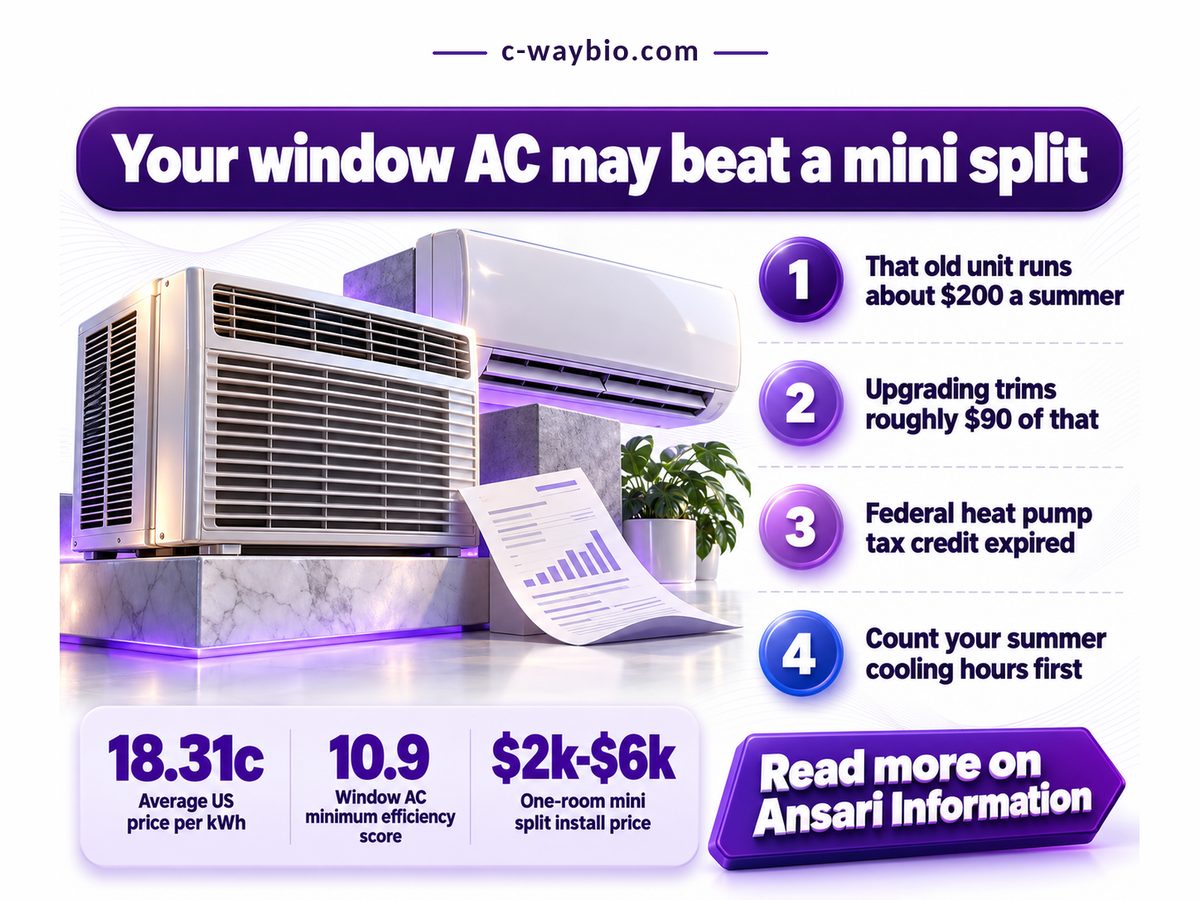
A window unit cooling one room through a 1,000-hour summer burns about $202 of electricity. A mini split doing the same job burns about $110. That $92 gap is the entire case in the mini split vs window ac argument, and it has to repay an install bill of thousands. Here is the sum, line by line, so you can swap in your own numbers.
TL;DR: keep a working window unit. Switching saves about $92 a summer, so a $3,000 install needs roughly 33 years to repay itself.
- Switch only when the window unit is dying, the room needs winter heat, or your building bans window units.
- Heavier use shortens the wait, but even 1,500 cooling hours a summer leaves about 22 years.
- The federal heat pump credit has ended, so electricity savings carry the whole sum.
Is a mini split worth it over a window unit?
No, not on cooling savings alone: at the average US residential price of 18.31 cents per kilowatt-hour, a mini split's electricity saving is worth under $8 a month averaged over a year.
That price is the July 2026 residential average in the Energy Information Administration's Electric Power Monthly (released 24 September 2026), up 4.9% on a year earlier. Rising prices favor the mini split, but 4.9% of a $92 saving is under $5 a year, so the trend will not rescue the payback.
Three assumptions, all mine: a 12,000 BTU/h (one-ton) unit running 1,000 full-load hours a summer, and a $3,000 install, inside the $2,000 to $6,000 Filterbuy's 2026 cost guide gives for one room (Carrier quotes $2,000 to $10,500 for 1,000 square feet).
- Window unit: the Department of Energy's floor for a louvered unit this size, built since 2014, is 10.9 CEER, a combined efficiency score in BTU of cooling per watt-hour. 12,000 ÷ 10.9 is about 1,101 watts, so 1,101 kWh over the summer, times 18.31 cents, is $202.
- Mini split: assume 20 SEER2, a seasonal score of the same kind. 12,000 ÷ 20 is 600 watts, so 600 kWh, which is $110. Carrier's single-zone line lists top ratings from 22.4 to 35.1 SEER2, so 20 is not a stretch.
- The gap: 501 kWh, or $92 a summer.
One caution: SEER2 averages a mild season while CEER is a single hot-day test, so the comparison tilts a little toward the mini split (I would rather say so than flatter the upgrade). We ran the same kWh-first method in rupees in our piece on pricing an AC by kWh instead of stars.
Four numbers decide the swap, and read together they turn a $92 headline into a decision.
Payback on a $3,000 install
33 years
Longer than a 30-year mortgage
Saving per month, averaged
$7.65
Lost inside an ordinary bill
Yearly saving for 10-year payback
1,638 kWh
Over triple what you save
Cooling electricity cut
46%
Real saving, small dollars
Take the yearly saving a ten-year payback demands. At the 501-watt gap between the two machines, reaching it would take about 3,270 full-load hours in a summer, which is 136 days of nonstop cooling. That is my arithmetic, not a published figure, and no ordinary room comes close.
Nearly half the electricity gone and still decades to repay: that is the whole case for keeping a working window unit.
A certain saving set against an upfront cost is a familiar shape: see a home loan prepayment against a SIP at the break-even rate.
Mini split vs window ac: the decision table
Stay with the window unit if it still works, and switch only when one of four conditions applies; the table prices each side so you can see which way every row pushes.
Read the left column first. A tick favors the swap, a warning sign means it depends on your home, and a cross counts against it.
| Dimension | Mini split vs window unit | What it means for you |
|---|---|---|
| 💰 Install price | Mini split $3,000 assumed Window $0 if it works |
❌ The whole install is your cost |
| 💰 Summer power | Mini split $110 Window $202 |
✅ Real saving, small in dollars |
| ⏱ Payback range | 600 hours 55 years 1,500 hours 22 years |
❌ Even heavy use repays slowly |
| 📊 Efficiency | Mini split 20 SEER2 Window 10.9 CEER |
⚠️ Different tests flatter the mini split |
| 🔋 Winter heat | Mini split Heats and cools Window Cooling only, usually |
⚠️ Matters if you heat that room |
| 🛠 Setup | Mini split Wall hole, outdoor unit Window Sits in an open sash |
⚠️ Rentals and HOAs may block it |
| 🏁 Best suited for | Mini split Dead unit, needs winter heat Window Working unit, cooling only |
🏁 Stay put unless a condition applies |
Only one row clearly favors the mini split, and it is about running it, not buying it.
Nearly three-quarters of what a mini split costs over ten years is the install, so the power bill never decides the payback. Derived from $3,000 up front plus ten summers at $110: my arithmetic, not a published figure.
What breaks the payback sum?
Cheaper power or fewer cooling hours stretch payback toward half a century, while a dead window unit or a winter heating need shrinks the gap the install has to repay.
At 12 cents a kWh, an assumption of mine, the $3,000 takes about 50 years; at 25 cents, about 24. Buying down does not help: the federal floor for heat pumps since 2023 is 14.3 SEER2, per Carrier's summary of the Department of Energy rule. A unit at that floor saves only $48 a summer against the window unit, so payback passes 60 years.
Tax credits used to bend this sum. The IRS page for the Energy Efficient Home Improvement Credit (last reviewed 28 April 2026) allows up to $2,000 a year for heat pumps, but only for property placed in service through 31 December 2025, so a 2026 install gets nothing. Whether your utility or state still pays a rebate is the open question, and my view is that a rebate you cannot see in writing is not a number.
- Get quotes with any rebate printed on them.
- Read the rated SEER2 on the exact model; the 20 here is an assumption.
- Count your real cooling hours: a room cooled only on summer evenings sits far below 1,000.
- If the window unit is dying, price its replacement and subtract it, because only the difference needs repaying, the same sunk-cost move as in paying a card annual fee instead of chasing its waiver.
Check these four conditions before you ask for a quote
- Your window unit has died, or you expect this summer to be its last.
- You heat this room in winter with a space heater or electric baseboard.
- Your lease, building or HOA bans window units, or the sash will not open.
- You run cooling around the clock for months, well past the top row of the table.
Stay with the window unit. Unless it is dying, the room needs winter heat, your building bans window units, or you cool around the clock for months, the swap is a 30-year bet at best. This week, pull last summer's electric bills, estimate your cooling hours honestly, and re-run the sum above with your own price per kWh before anyone hands you a quote.
No comments:
Post a Comment
Note: Only a member of this blog may post a comment.