₹26,000. That is the tax on a ₹25,000 raise at a ₹12.75 lakh salary, and the 12 lakh tax rebate will not shield it, because the word its label hides is taxable. Section 156 of the Income-tax Act 2025 ends the rebate at ₹12 lakh of taxable income, not salary. You pay what sits above that line, not your employer.
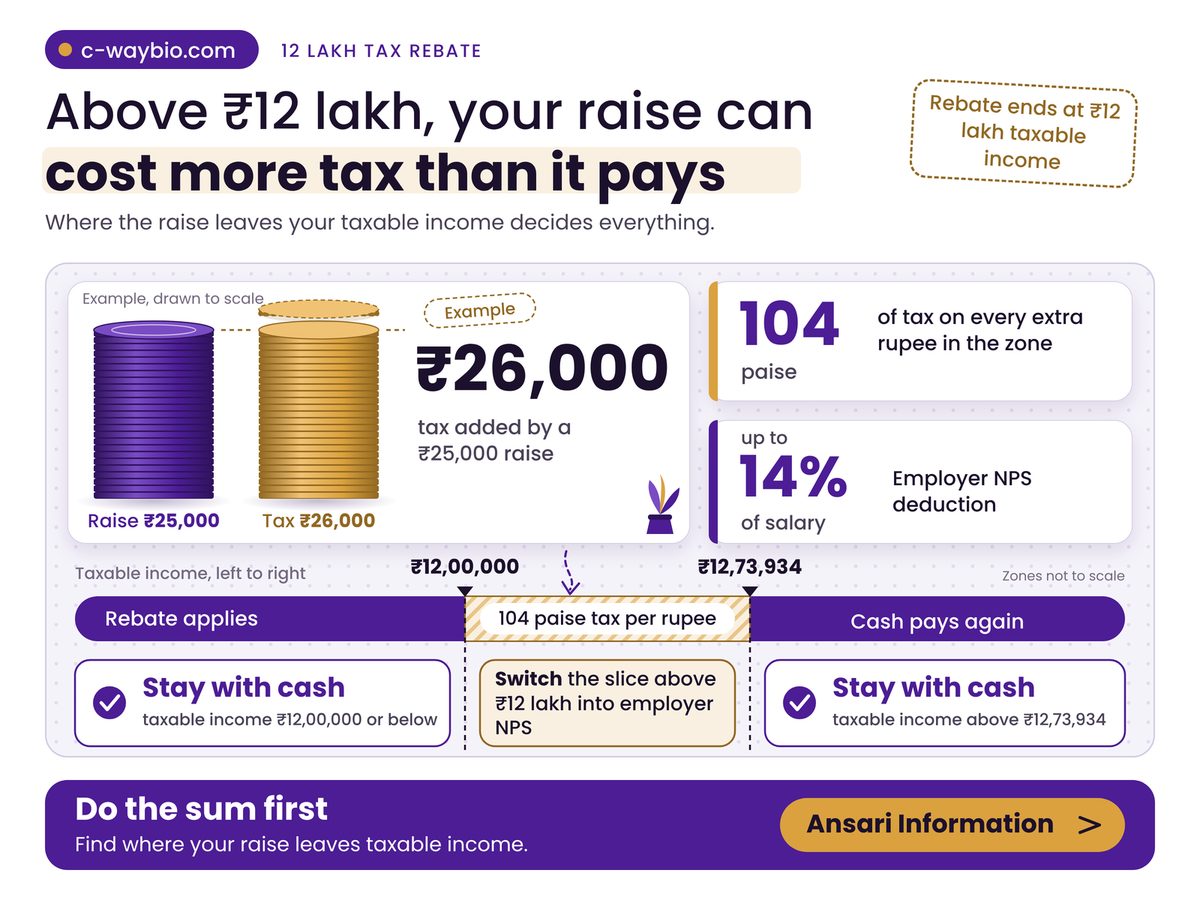
Past ₹12 lakh of taxable income, a small raise can cost more tax than it pays.
- A ₹25,000 raise at a ₹12.75 lakh salary adds ₹26,000 of tax, so you keep minus ₹1,000.
- Your line is taxable income: salary less the ₹75,000 standard deduction and any employer NPS.
- Rule: if the raise leaves taxable income between ₹12,00,001 and ₹12,73,934, send the slice above ₹12 lakh to employer NPS or defer it.
- Above ₹12,73,934, cash pays again and you keep 84.4 paise of each rupee.
Why it matters: does the 12 lakh tax rebate stop at ₹12 lakh of taxable income?
Yes: at ₹12 lakh of taxable income the rebate wipes out tax of up to ₹60,000, but one rupee higher, relief only caps your tax at the rupees earned above the line.
Read the statute, not the headline. Section 156(2)(a), read on the Income Tax Department's site on 23 November 2026, grants "100% of the income-tax payable or Rs. 60000, whichever is less" up to twelve lakh. Tax at exactly ₹12 lakh is ₹60,000 on the section 202(1) slabs, so the rebate erases all of it.
Clause (2)(b) is the cliff. Above ₹12 lakh it caps your tax at the amount by which income exceeds ₹12 lakh. Business Today reported on 3 February 2025 that ₹12,10,000 pays ₹10,000, not ₹61,500, as this clause implies. Our arithmetic: relief stops biting where ₹60,000 plus 15% of the excess equals the excess, so ₹60,000 ÷ 0.85 gives a zone of ₹70,588, taxed at 100% plus 4% cess. Our view: "₹12.75 lakh is tax free" is stale advice for anyone expecting a raise.
Four numbers decide whether a raise helps, and each is our arithmetic on the Act's own figures.
Tax On A ₹25,000 Raise
₹26,000
Derived: more tax than raise
Tax Per ₹1 Inside The Zone
104 paise
Derived: relief cap plus cess
Width Of The Dead Zone
₹70,588
Derived: taxable rupees above ₹12 lakh
Monthly Cost Of Saying Yes
₹83 a month
Derived from the ₹1,000 loss
The width of that zone is the part to remember. It swallows any raise that keeps taxable income inside it, or rather any raise that ends inside it, since a raise starting below the line still gains.
Zero tax up to a ₹12.75 lakh salary is true. A raise from there is not free: across the next ₹70,588 of taxable pay, you hand over more than you earn.
Worked example: take a salaried resident on ₹12,75,000, no employer NPS, the ₹75,000 standard deduction (the department's salary deductions page, uploaded 30 April 2026) and a ₹25,000 cash raise. Taxable income is ₹12,00,000 now, with nil tax; after the raise it is ₹12,25,000. Slab tax would be ₹60,000 plus 15% of ₹25,000, or ₹63,750, but relief caps it at the ₹25,000 excess. Add 4% cess (₹1,000) and the extra tax is ₹26,000. You keep ₹25,000 less ₹26,000, so minus ₹1,000 a year, about ₹83 a month. That gap is your cliff cost.
If you keep the cash, the next sum is where it goes. Our VPF versus PPF comparison in rupees and our home loan prepayment against SIP break-even both start from a post-tax rupee, which is exactly what the cliff shrinks.
Is ₹12.75 lakh really tax free once you get a raise?
Yes for the salary itself, since ₹12.75 lakh less ₹75,000 is exactly ₹12 lakh of taxable income, but the first rupees of any raise land in the zone, so what you keep depends on where you start.
Find your salary across the top and your raise down the side; each cell shows what you keep after tax and 4% cess.
| Your raise | ₹12.75L | ₹13L | ₹13.5L |
|---|---|---|---|
| ₹10k raise | -₹400 | -₹400 | ₹8,440 |
| ₹25k raise | -₹1,000 | -₹1,000 | ₹21,100 |
| ₹50k raise | -₹2,000 | ₹1,900 | ₹42,200 |
| ₹75k raise | ₹900 | ₹23,000 | ₹63,300 |
| ₹1L raise | ₹22,000 | ₹44,100 | ₹84,400 |
Our arithmetic: the shaded cell is the ₹25,000 raise at a ₹12.75 lakh salary, minus ₹1,000. One step down doubles the loss. One step right changes nothing: ₹13 lakh is still inside the zone. Past the zone, tax is ₹62,400 plus 15.6 paise a rupee, so a raise catches its tax only at ₹62,400 ÷ 0.844, or ₹73,934 above the line.
The graphic settles one question: how much of a ₹100 raise you keep when it lands in the zone and when it lands past it. Our arithmetic: 100% relief cap plus 4% cess is 104 paise per rupee in the zone, and 15% plus 4% cess leaves 84.4 paise past it.
Friction points: is 4% cess charged on the tax left after marginal relief?
Our reading is yes: the Income Tax Department's computation FAQ adds 4% cess to the tax liability left after relief, so a capped tax of ₹25,000 becomes ₹26,000.
The FAQ shows this in two surcharge examples, not the section 156 rebate, so the ₹26,000 is our interpretation. Our view: assume cess applies. If the department rules otherwise, the loss turns into a zero, and the advice below holds.
Employer NPS is the usual way out, and it is narrower than it sounds. Section 124(2) lets you deduct the employer's contribution up to 14% of salary (basic plus dearness allowance, where your terms include it) when income is taxed at section 202(1) rates. Your employer must agree, and the money stops being spendable cash.
- Total income means all of it. Interest and rent taxed at slab rates count toward the same ₹12 lakh, though your payslip never shows them.
- No standard deduction, no ₹12.75 lakh. The ₹75,000 is for employees, so a freelancer's line sits at ₹12 lakh of gross income.
- Income taxed at special rates, such as capital gains, is a separate sum this article does not run.
Check these four things before you reply to HR
- Your payslip tax sheet or Form 16 projects taxable income above ₹12,00,000 after the raise.
- Your CTC letter has an employer NPS line, or HR confirms in writing that it can add one.
- Your basic pay, multiplied by 14%, covers the slice you would redirect.
- Interest or rent outside your payslip is added before you measure the line.
Keep the cash and you meet the next leak: our piece on digital gold against a gold ETF after SEBI's caution prices one.
Stay with cash if the raise leaves taxable income at ₹12,00,000 or below, or above ₹12,73,934. Switch the slice above ₹12 lakh into employer NPS if it lands between those two numbers. Your cliff cost is the figure to take into that talk. The one-minute line check: new salary, less ₹75,000, less any employer NPS. This week, ask HR whether your CTC can carry an NPS line before you accept. The call is wrong if you are not salaried, because your line then sits at ₹12 lakh gross; the rule itself is on the section 156 page.
How we checked this
We read section 156, section 202 and section 124 of the Income-tax Act 2025 and the computation FAQ on the Income Tax Department's site on 23 November 2026. We derived the zone, the 84.4 paise rate and the ₹73,934 break-even from a ₹12,75,000 salary with no employer NPS. No product was tested hands-on for this article. Last verified: 23 November 2026.
Edited by Ansari, reviewed after publication. Spotted something out of date? Tell us and we will correct it.
No comments:
Post a Comment
Note: Only a member of this blog may post a comment.