Tuesday, September 22, 2026

FD vs Debt Fund: The Tax Gap on ₹5 Lakh

₹1,949. That is the entire prize for moving ₹5 lakh out of a three-year SBI fixed deposit into a debt fund, at the 30% slab, if the fund behaves. A cousin calls debt funds "more tax-efficient", and you are one click from breaking a deposit. Run the fd vs debt fund sum first. A phone calculator can check it.
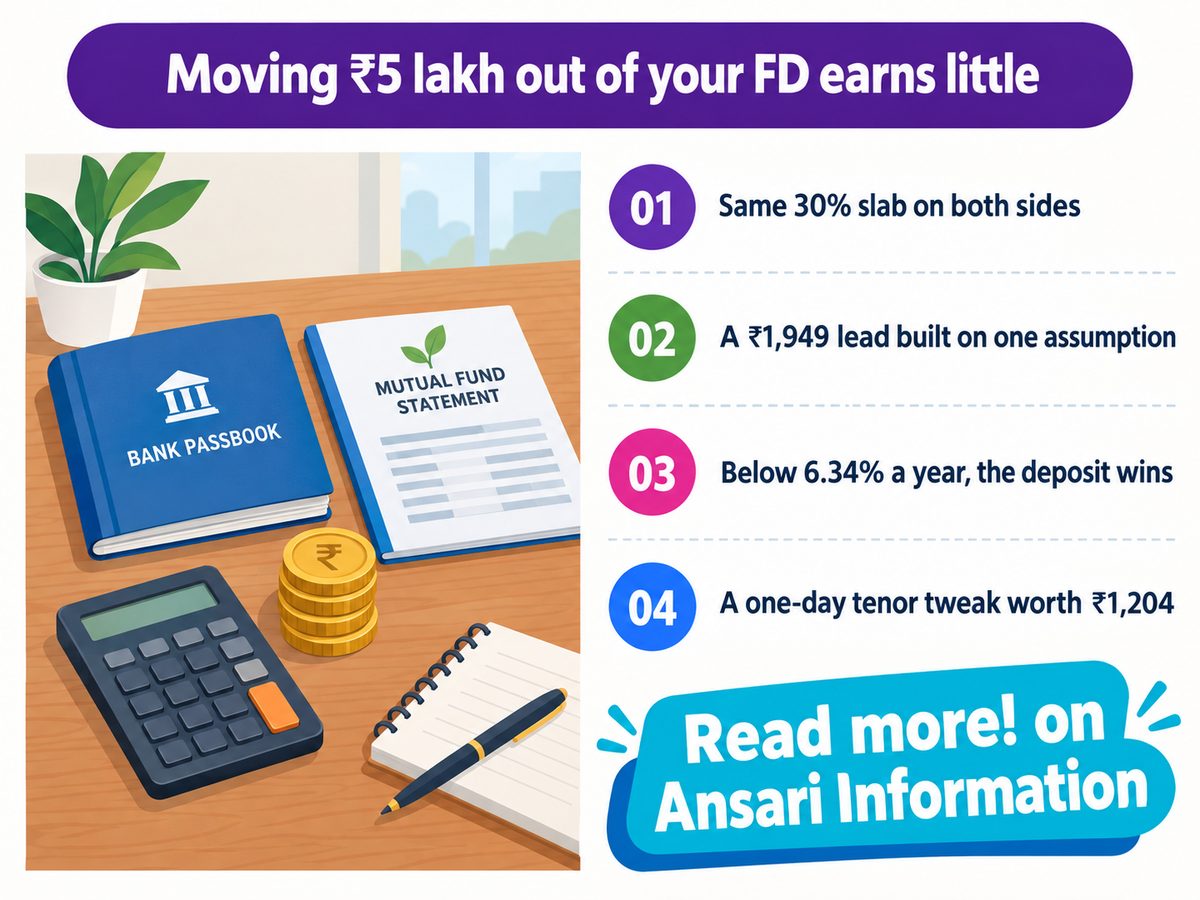
Passbook, fund statement and calculator weighing fd vs debt fund on ₹5 lakh

TL;DR: At the 30% slab with ₹5 lakh for three years, stay in the FD. The debt fund leads by under ₹2,000, on an assumed yield.

  • Debt fund units bought since April 2023 are taxed at your slab, exactly like FD interest.
  • The fund's only structural edge is paying tax once, at exit.
  • A fund netting less than 6.34% a year loses to a 6.30% three-year FD.
  • Senior citizens should not switch: SBI's senior rate wins outright.

Are debt funds better than FDs after the 2023 tax change?

Not for most savers, because gains on debt fund units bought since April 2023 are taxed at your income slab, so the old tax-rate advantage has gone and only the timing of the tax bill still differs.

ClearTax's summary is blunt: units bought on or after 1 April 2023 count as short-term whatever the holding period, taxed at slab, no indexation. At 30%, the government takes the same share from either product, so the choice turns on when you pay. It is the discipline behind deciding whether to renew or port a health policy after the GST exemption: strip the label, price the rupees.

Here is the whole sum, before cess. SBI's card, tabulated by GoldenPi for September 2026, pays 6.30% on three-to-five-year deposits; quarterly compounding makes that 6.45% a year. Banks count interest as it is credited, so the FD's tax comes out yearly. The fund's 6.5% net yield is an assumption, a planning number for a short duration debt fund, not a promise.

  • FD: ₹1,01,190 of interest over three years, taxed each year at 30%, costs ₹30,357. You keep ₹5,70,833.
  • Debt fund: ₹5,00,000 grows to ₹6,03,975. Tax at exit on the ₹1,03,975 gain is ₹31,192. You keep ₹5,72,782.
  • Gap: ₹1,949 to the fund, roughly ₹54 a month for carrying market risk.

Split the gap, because its halves deserve different trust. Taxed in one lump at maturity, the FD would end at ₹5,72,192, so ₹1,359 is pure deferral. The other ₹590 exists only because the fund was assumed to earn a shade more, which, frankly, is the part I trust least. Unseen costs still cost, as UPI transaction charges after the zero-MDR repeal showed.

Four more numbers decide your side of the sum: ClearTax on pre-April-2023 units, Business Standard on the February 2025 Budget's TDS limit, Indian Pay Calculator reporting SBI Research on 12 September 2026, and GoldenPi's senior rate.

Old Units Turn Long-Term After

24 months

Then 12.5%, not 30%

FD Interest a Year Before TDS

₹50,000

Your ₹5 lakh stays under

Repo Hikes SBI Research Expects

2 by December

Lock short, not long

SBI Senior Rate, 3 to 5 Years

6.80%

FD beats the fund outright

Rerun the sum at the senior rate and the deposit ends at ₹5,76,876, ₹4,094 ahead of the fund. A retired parent has no tax reason to switch.

"

The debt fund's whole edge on ₹5 lakh is paying the same tax later. Three years of delay buys you less than ₹2,000, and one assumption can take it back.

So the real question is whether the timing gap survives what the sum cannot know.

FD vs debt fund on ₹5 lakh: the row-by-row verdict

On ₹5 lakh for three years at the 30% slab, both products tax the gain at the same rate, and the fund's small lead hangs on timing, its yield and when you exit.

The badge names what each row measures; the last column says what it does to your money.

Dimension Fixed deposit vs debt mutual fund What it means for you
๐Ÿ’ฐ Tax on gain FD 30% slab, yearly
Fund 30% slab, at exit
⚠️ Same bite; only the date moves
⏱ Tax timing FD 3 bills, one a year
Fund 1 bill, on redemption
✅ Deferral is the fund's only real edge
๐Ÿ“Š Take-home FD ₹5,70,833, fixed
Fund ₹5,72,782, assumed
⚠️ Lost if the fund nets under 6.34%
๐Ÿงพ TDS FD 10% past ₹7.75 lakh
Fund None for residents
✅ Large balances keep cash compounding
๐Ÿ”’ Rate risk FD Locked for 3 years
Fund About ₹1,250 per 25 bp
❌ An early exit after a hike eats the lead
๐Ÿ Best suited for FD Seniors, or cash needed soon
Fund Sums past the TDS limit
๐Ÿ Most 30%-slab savers should stay put

Only one row is yours to control: whether you might need the money early. If so, the fund's lead is a coin toss; the deposit's outcome is already on the receipt.

₹1,949. fund's 3-year lead. Tax deferral 70%. ₹1,359 · paying later. Extra yield 30%. ₹590 · assumed only.

Most of the debt fund's lead is the tax delay rather than better returns, so a fund that merely matches the deposit's yield leaves you switching for about ₹1,360 over three years. Derived from this article's own sum: SBI's three-year card rate against an assumed fund yield, both taxed at 30%.

Should I break an FD to move into a debt fund?

Only if the money is large enough to trip TDS and you are certain you will not touch it for three years; otherwise the switch trades a fixed, known rate for a lead smaller than one month of the deposit's interest.

Rates are the part nobody can sum in advance. With the repo at 5.25%, a hike cuts a debt fund's NAV at once; assume one year of duration and each 25 basis points costs about ₹1,250 on ₹5 lakh. Hold the full term and higher accrual repairs it. Exit soon after two hikes and the lead is gone. "Debt funds are tax-efficient" was true before April 2023, so judge the claim now the way you would price an AC by kWh, not stars.

One lever sits inside the deposit. SBI pays 6.40% for two years to under three; book two years and 364 days and the FD ends at ₹5,72,037, clawing back ₹1,204 without leaving the bank. Check dates too: Tax Garden's guide, updated 21 September 2026, notes the TDS rule now sits in Section 393(1) of the Income Tax Act 2025, not Section 194A, so older guides may quote stale rates.

  • Units bought before April 2023: keep them, or swap a lower long-term rate for your slab.
  • Emergency money: a fund redeemed within a year carries NAV risk.
  • Big balances at one bank: TDS withholds cash yearly, not extra tax.

Switch only if every line is true for you

  • You will not need this money for three years.
  • You are under 60 and do not qualify for the senior deposit rate.
  • A fund you can name has cleared the table's break-even after expenses.
  • Your interest at one bank would otherwise cross the TDS limit.

Stay. At the 30% slab, the FD gives up under ₹2,000 on ₹5 lakh in exchange for certainty. This week, pull out your FD receipt, check the tenor, and at renewal rebook for two years and 364 days instead of three. Switch only if every line on the card describes you.
Related: home loan prepayment vs SIP: the break-even return

Monday, September 7, 2026

UPI Transaction Charges 2026: Who Pays

The QR code taped to your chaiwala's counter did not change last month. The law behind it did. On 8 August 2026 Parliament removed the clause that had made UPI free by statute, and within a day the question doing the rounds on every family group chat was whether UPI transaction charges were about to start appearing on your bank statement. Short answer: not yours. Longer answer: it depends on whose till you are standing at, and nobody has published a number yet.

Proportion bar comparing UPI transaction charges with debit and credit card MDR rates

No, you will not pay UPI transaction charges on an ordinary payment, and the August 2026 law change does not say you will.

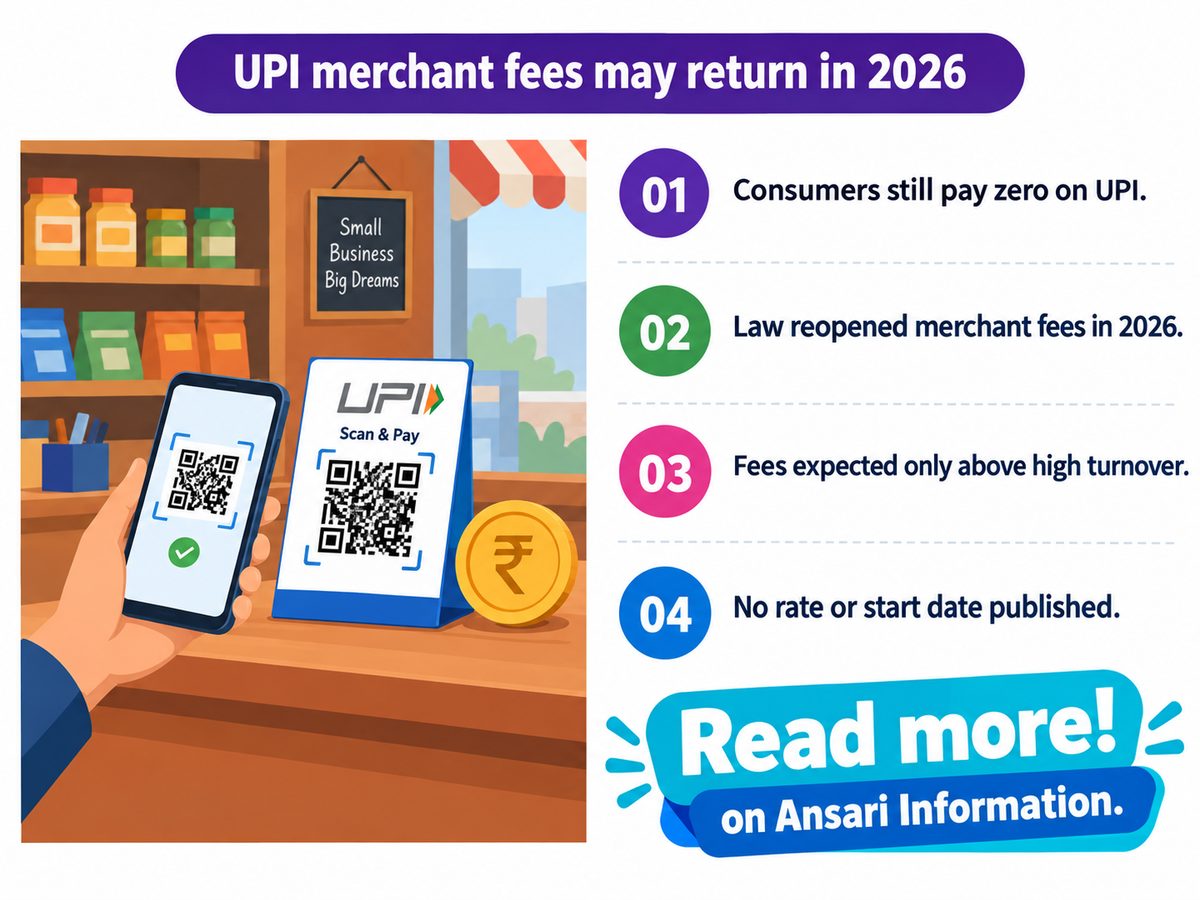
  • Section 10A of the Payment and Settlement Systems Act was amended on 8 August 2026, making merchant fees legal again.
  • The Finance Ministry has committed to zero cost for consumers and all person-to-person transfers.
  • Any fee is expected only above a high merchant turnover line, so small counters stay outside it.
  • No rate, no start date and no surcharge rule has been published.

Will UPI be charged now that the zero-MDR law is gone?

No, not on your side. The August 2026 amendment makes it legal for banks to charge merchants for accepting UPI, but the Finance Ministry has ruled out any fee on consumers or on person-to-person transfers. That distinction is the whole story.

UPI stopped being a payment method some years ago. It is the road now. NPCI figures reported by Business Standard on 1 September 2026 put August at ₹29.82 trillion moved, a daily average of 791 million payments. Rails carrying that much traffic cost real money to run, and nobody has been collecting a paisa at the point of sale to cover it.

What actually changed is narrower than the headlines suggested. The Lok Sabha passed the Taxation and Other Laws (Amendment) Bill, which edits Section 10A of the Payment and Settlement Systems Act, 2007. That section is the one that banned charges on UPI and RuPay debit outright. Removing a prohibition is not the same as imposing a fee, and the two got flattened into a single story within hours of the vote, the same way the GST exemption on health insurance turned into a promise of cheaper premiums that never arrived.

Here is the part that stays out of the headlines. Free was never free, it was subsidised. The Centre has been paying acquiring banks to keep small-merchant UPI running, and the Standing Committee on Finance found that money covered only a sliver of what the industry actually spent to keep the rails up.

August 2026 volume

24.51 bn

UPI payments in one month

Centre's incentive payout

₹8,730 cr

Paid across 2021-22 to 2024-25

Share of industry cost met

11%

Standing Committee on Finance

Zero-MDR in force

6 years

Before the 2026 repeal

Work backwards from the share of industry cost that subsidy actually met, and the arithmetic gets uncomfortable: the payments industry has been absorbing something close to ₹19,800 crore a year to keep your QR scan free. That is my own calculation from the two published figures above, not a number anyone has announced. Costs buried inside a supply chain do surface eventually, usually in the price of the thing itself, the way memory component prices surfaced in what a new phone costs in India. What the amendment does is move that cost out of a subsidy line and toward the businesses collecting the money.

"

Six years of free rails cost the industry far more than the Centre ever repaid. That gap, not any appetite for your money, is what reopened Section 10A.

Where UPI transaction charges actually land today

Every rupee of cost currently sits with banks and payment service providers, not with you and not with the shopkeeper. The amended law lets that shift toward larger merchants, but no rate and no start date exists yet, so today's position is unchanged.

The Finance Minister said on 17 August 2026 that no framework has been finalised, and Business Standard counted six operational questions still open, including whether a merchant would even be allowed to pass the fee on to you at the counter. That last one matters far more to a household than the rate does. Here is what is settled and what is not.

CategoryDetailInsight
The law Section 10A of the Payment and Settlement Systems Act, 2007, amended by the Lok Sabha on 8 August 2026 Charging became legal, not automatic
Your side Person-to-person transfers and consumer-side payments stay free, per the Finance Ministry Nothing to pay, nothing to do
Merchants UPI charges for merchants are expected only above roughly ₹50 crore annual turnover, with ₹1 crore to ₹1.5 crore also proposed Small counters sit outside the line
Rate No published figure for UPI MDR charges, only "nominal" and below existing card rates Treat any quoted percentage as rumour
Subsidy ₹1,500 crore for FY 2024-25 at 0.15% per transaction, on small-merchant payments up to ₹2,000 Covers roughly ₹10 lakh crore of value
Surcharge Whether a merchant may pass the fee to you is one of six unsettled design questions Undecided, and the one to watch
Decision NPCI's UPI Services Steering Committee sets eligibility, rate, revenue split and reversals No date announced as of September 2026
Today ₹0 on a bank-to-bank UPI payment, whichever app you use Unchanged since 1 January 2020

Two rows there deserve a second look. The subsidy row shows how narrow the protected band really is, because a scheme sized for payments under two thousand rupees was never going to cover the whole economy. The surcharge row is the one to keep an eye on, since a rate you never see beats a rate you pay at the counter.

Is UPI free for person-to-person payments?

Yes, and that is the one commitment the Finance Ministry has made with no threshold attached to it. Sending money to a friend, settling a shared bill or paying rent into a landlord's account carries no fee, and none has been proposed in any version of the framework.

Merchant payments are the contested ground, which is why the debate keeps circling back to turnover bands rather than to you. It helps to see where UPI sits against the rails it replaced.

What each rail costs the merchant, per rupee collected. UPI and RuPay debit. 0%. Debit card, small merchant. 0.4%. Debit card, larger merchant. 0.9%. Credit card, typical. About 2%. Bar length shown to scale. Zero is drawn as a marker.

Merchant discount rates by payment rail, from the RBI caps and the Payments Council of India structures compiled by Razorpay, retrieved 8 September 2026.

Friction points before any of this settles

The risk to your wallet is not the merchant fee itself, it is what a shopkeeper does in response to one. Surcharging at the counter, or a quiet switch back to cash on small bills, would reach you long before any bank charge ever could.

Policy here moves faster than it looks from outside. In June 2025 the Finance Ministry said publicly that there was no plan to levy a merchant fee on UPI. Fourteen months later the statutory bar was gone. I am not suggesting anyone was being dishonest, positions do change once a bill is actually drafted. What I am saying is that a commitment to keep consumers free is a policy stance rather than a statutory protection, and those two things behave very differently when the pressure comes on.

There is a second thing worth watching, and it sits with your bank rather than with the government. Nothing in this amendment stops a bank from repricing the features wrapped around your account: free ATM withdrawal limits, minimum balance slabs, the charge for a physical statement. Those have always been commercial decisions and they never needed a Section 10A change to happen. A payment that stays free inside an account that quietly gets more expensive is still a worse deal, and it is the sort of thing that only shows up when you compare a full year against the one before it, in the same way that an appliance label is worth less than the annual running-cost figure printed beside it.

  • A handwritten "charges apply" sign next to a QR code. Ask before you scan, because no rule permitting it exists yet.
  • A minimum bill value for UPI at small counters, which is the informal version of the same fee.
  • Your own bank changing what is free around the account rather than on the payment.
  • Any forwarded message quoting a specific percentage. Nothing has been published, so it is invented.

Act on this, not on the headline

Change nothing today. A bank-to-bank UPI payment has no consumer fee and no scheduled start date for one, so switching apps or moving to cash solves a problem you do not have.

Watch the counter, not the news cycle. The first real signal will be a merchant asking you to cover something, and that is the point at which the rule is worth reading closely.

If you run a business, find your turnover band. Every proposal on the table draws the line by annual turnover, so the only number that decides whether this reaches you is one you already file.

Do one thing this week. Open your main UPI app, pull up last month's transaction history, and total what you actually pushed through it. Not because a fee is coming for you, but because most people have no idea how much of their monthly spending now rides on a rail whose economics are being rewritten in public, and that total is the number that will matter if the policy stance ever softens. If you want a companion exercise in reading the real cost of a service you already pay for every month, the same arithmetic applies to what a home broadband connection actually costs once you compare the two ways of buying it.

Related: whether a credit card annual fee waiver is worth chasing