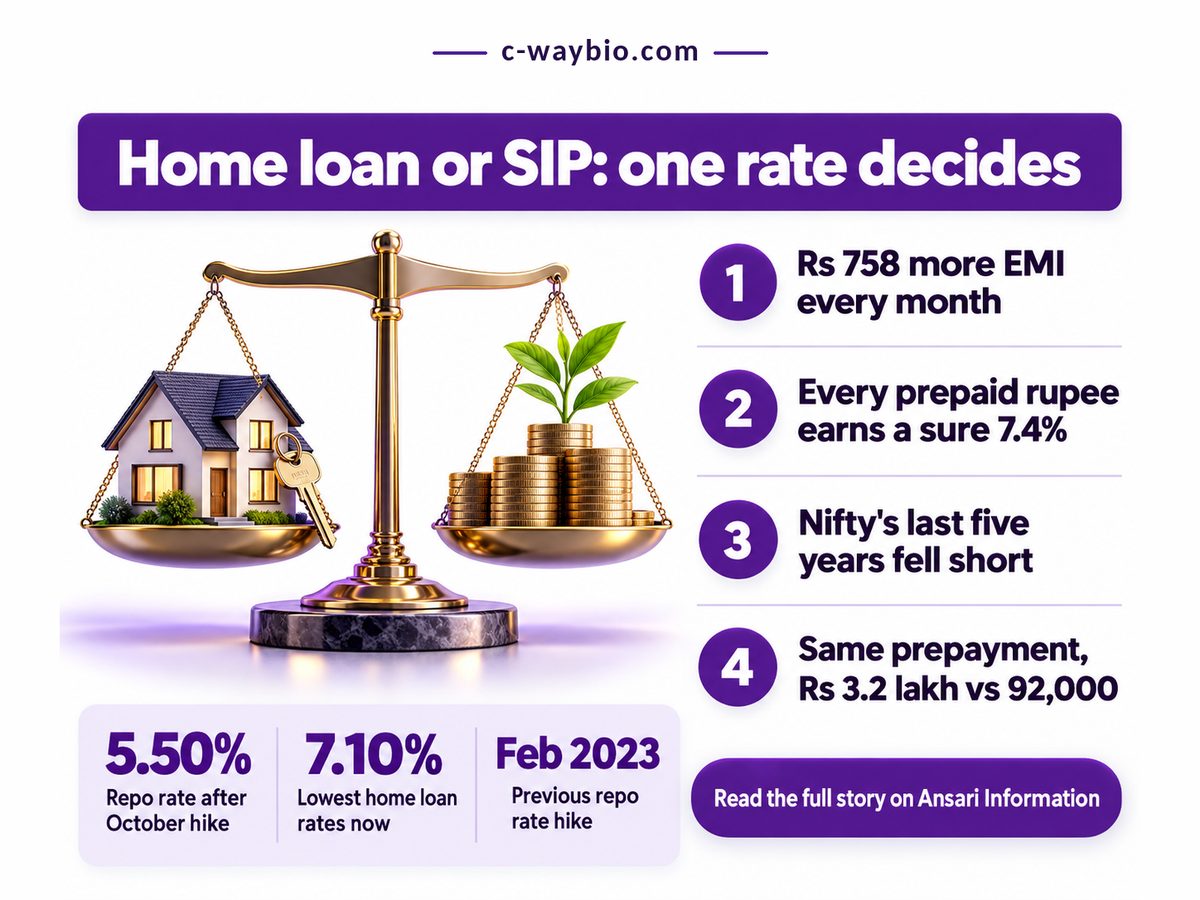
₹758 a month. That is what Wednesday's repo hike adds to a ₹50 lakh, 20-year home loan as its rate moves from 7.15% to 7.40%, taking the EMI from ₹39,216 to ₹39,974 in Paisabazaar's worked example. Call it ₹9,100 a year, or a longer loan if your bank stretches the tenure instead. If you also run a monthly SIP, the hike reopens home loan prepayment vs SIP, and this time the sum is closer than the usual advice admits.
Key Takeaways
Prepay if your SIP can't reliably beat about 7.7% to 8% a year before tax; keep the SIP if you have 15 years or more and a full emergency fund.
- A prepaid rupee earns your loan rate, tax-free and riskless.
- Nifty 50's last five years returned less than a 7.4% loan costs.
- Ask the bank to cut the tenure, not the EMI: the interest saved is about 3.5 times larger.
- Old-regime filers lose no deduction by prepaying while yearly interest stays above the cap.
Why the repo hike reprices home loan prepayment vs SIP
Because a prepaid rupee earns exactly your loan's interest rate with no risk, every repo hike raises the return on prepaying, and it lifts the after-tax return a SIP must beat by the same amount.
The Reserve Bank of India raised the repo rate by 25 basis points to 5.50% on 7 October 2026, its first increase since February 2023, according to Paisabazaar. Floating home loans reprice at their next reset, so the guaranteed return on prepaying climbs while your SIP's expected return stands still.
The other side is less comfortable. NSE Indices' Nifty 50 factsheet, dated 30 September 2026, shows the index's total return (dividends reinvested) compounding at 6.38% a year over five years. An index SIP over that stretch earned less than your loan now costs. Since launch the index has compounded at 12.12%, the number every "invest, don't prepay" argument leans on, but that describes a 15-year-plus holding.
Tax widens the gap. Equity gains held over a year are taxed at 12.5%, so the SIP has to earn more than the loan rate just to tie, while the interest you avoid by prepaying is never taxed. Paisabazaar lists home loans from 7.10%, so even the best-priced borrower earns at least that, risk-free, on each prepaid rupee. Same discipline as the post-tax gap between an FD and a debt fund: compare what lands in your hand, not the headline rate. It is the sure-saving-versus-hoped-for-gain trade from credit card annual fee waivers, with bigger numbers.
Our own working on that example loan, with ₹1 lakh prepaid at the reset, gives the four numbers that decide this.
Loan Shortened by ₹1 Lakh
10 months
Debt-free that much sooner
Interest Saved by That Lakh
₹3.24 lakh
Over three times the payment
Year-One Interest on ₹50 Lakh
₹3.66 lakh
Far above the deduction cap
Old-Regime Loan Cost, 30% Slab
5.2%
Only once interest is capped
That interest figure assumes you tell the bank to keep the EMI and shorten the loan. Ask for a lower EMI instead and the same lakh saves only about ₹91,900, because the bank re-spreads your balance over the full remaining term. The EMI falls by roughly ₹800, which helps only if you invest it, monthly, above the loan rate. Most people don't.
One lakh prepaid buys back ten months of EMIs. No SIP will put a guarantee like that in writing.
So it turns on one question: what return can you honestly expect, after tax, over the years your loan has left?
Is it better to prepay a home loan or invest in a SIP?
Prepaying is better unless you can reasonably expect your SIP to earn more than about 7.7% to 8% a year before tax, over 15 years or more, with an emergency fund already in place.
| Dimension | Prepay vs SIP | What it means for you |
|---|---|---|
| 💰 What you earn | Prepay Your loan rate, 7.4% now SIP Market-linked, never fixed |
⚠️ You trade certainty for a bigger maybe |
| 🧾 Tax on gains | Prepay Nothing on interest saved SIP First ₹1.25 lakh/yr tax-free |
✅ Modest SIPs feel little tax drag |
| ⏱ Time needed | Prepay Works from the next EMI SIP 15+ years for long-run pace |
⚠️ Under 15 years, equity is a coin toss |
| 📊 Bar to clear | Prepay Rises with every repo hike SIP 7.7% to 8% a year pre-tax |
⚠️ Test your fund's 10-year record against it |
| ⚖️ Old tax regime | Prepay Full rate until year 14 SIP Taxed the same either way |
✅ Early prepaying costs no deduction |
| 🔒 Cash access | Prepay Locked until loan closes SIP Sell on any trading day |
❌ Prepaid money can't pay a hospital bill |
| 🛠 How to apply it | Prepay Cut tenure, keep the EMI SIP Same date, every month |
✅ Tenure cuts save 3.5 times the interest |
| 🏁 Best suited for | Prepay New regime, under 15 years SIP 15+ years, cash buffer full |
🏁 Can't count on 8%? Prepay |
Read the right-hand column: the SIP wins only on time. Without a long horizon and a cash buffer, the loan wins.
If your SIP cannot reliably earn about 7.7% a year before tax for 20 years, the lakh belongs in the loan. Our derivation: ₹1 lakh compounded 20 years at each rate, after capital gains tax, on NSE Indices data.
When should you not prepay a home loan?
Skip the prepayment if it would drain your emergency fund, or if you file under the old tax regime and your yearly interest has already fallen below the deduction cap; in both cases the SIP keeps the edge.
Old-regime filers can deduct up to ₹2 lakh a year of interest on a self-occupied home, per the Income Tax Department; the new regime allows nothing. On this loan that changes little, at least not yet: yearly interest stays above the cap until year 14, so early prepayment cuts interest you were never deducting.
Liquidity is the harder limit. If a hospital bill would push you onto a credit card, fix that first, starting with whether to renew or port your health insurance. Honestly, a family with thin cover shouldn't run this sum yet.
- Penalty: RBI's Pre-payment Charges on Loans Directions, 2025 bar charges on personal floating-rate loans sanctioned or renewed from 1 January 2026, so part-payments cost nothing extra.
- Next hike: SBI Research forecasts another 25 basis points in December 2026; that would lift this loan's bar to about 7.65%.
Prepay this month only if all of these hold:
- Your lender's next reset carries a rate of 7.4% or higher.
- Six months of expenses already sit in a liquid fund.
- New regime, or yearly interest still above the old-regime cap.
- You might need this money within 15 years.
Any line fails: keep the SIP and revisit at the next reset.
Stay or switch? Stay with the SIP if you have 15 years to run, a full emergency fund and the stomach for another five years like the last. Otherwise, switch. This week, find your next reset date and rate in your lender's portal, and if the card says prepay, send ₹1 lakh with a written request to cut the tenure, not the EMI.
No comments:
Post a Comment
Note: Only a member of this blog may post a comment.