Six per cent. That is roughly what an app's digital gold gives up between buying and selling, before the gold price moves a paisa. A gold ETF charges no toll at the door; it skims a small fee every year instead. So the digital gold vs gold ETF question is one sum: how many years of that fee add up to the toll?
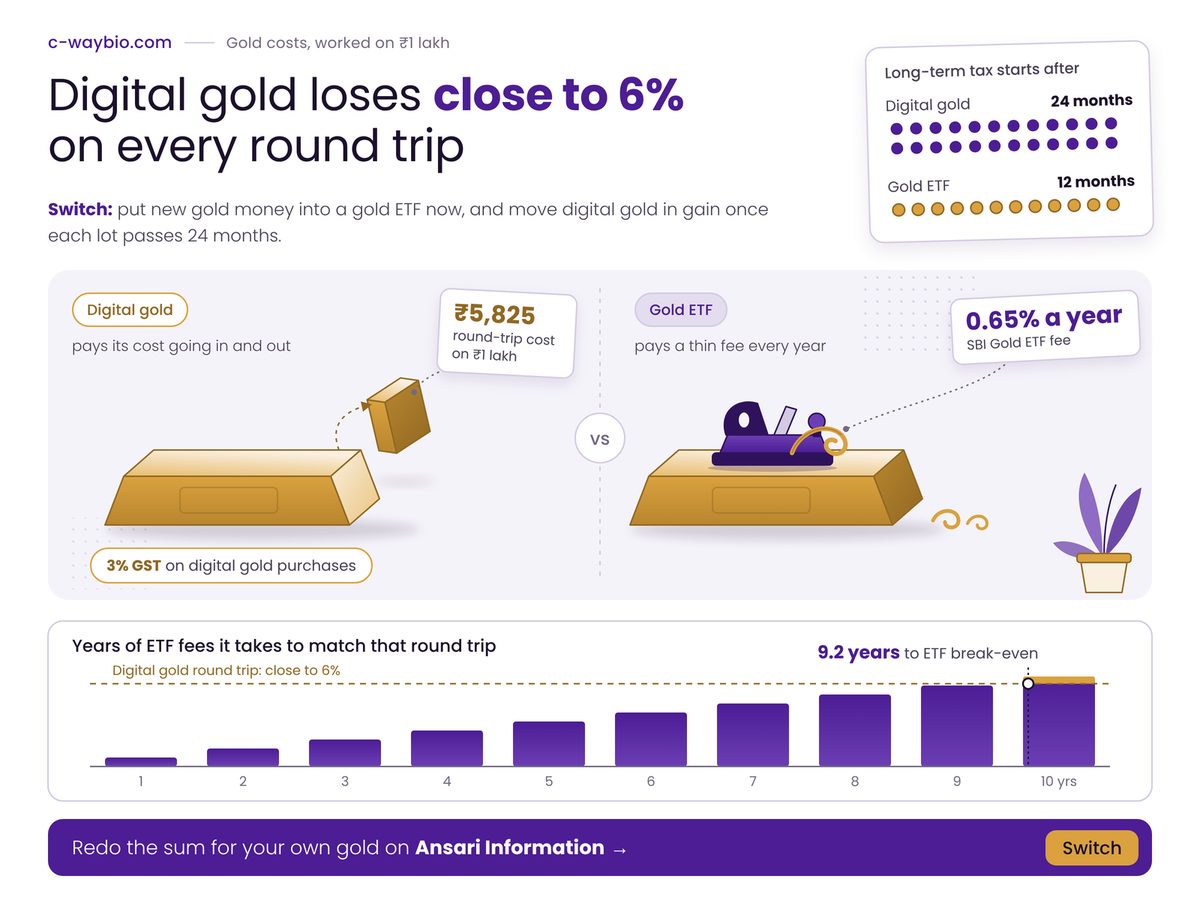
Key Takeaways: New gold money belongs in a gold ETF, and digital gold you already hold should move once each lot passes 24 months.
- Digital gold loses close to 6% on a round trip: 3% GST in, the spread out.
- A 0.65% yearly ETF fee needs about 9.2 years to cost as much.
- Selling digital gold inside 24 months taxes any gain at your slab rate.
- SEBI says digital gold sits outside its purview, with no investor protection.
Is digital gold safe after the SEBI warning?
Not in the regulated sense: SEBI said on 8 November 2025 that digital gold is neither a security nor a commodity derivative, so none of the securities market's investor protections apply if the platform fails.
That is the reading of SEBI press release 70/2025, as Moneylife reported its wording, and it steers buyers to gold ETFs. If the app or its vault partner folds, you have no SEBI complaint route and no investor-protection fund. Whether vault and trustee arrangements hold when an app shuts is the open question; our view is that an untested promise is worth less than a regulator's rulebook.
Price is the other half. Bajaj Finserv AMC's explainer, updated March 2026, lists GST at 3% on digital gold purchases, so part of every rupee buys tax, not metal. Selling costs again through the buy-sell spread, which Weekend Investing's Alok Jain told Business Today in October 2025 can reach 5%, enough to erase a good year for gold. The same report cites a FinPrint check where three platforms showed 2% to 3.6% losses on October dates when the IBJA benchmark showed a profit: short holds can lose in a rising month.
A user on a payments app's community forum wrote in April 2024 that the app showed about ₹60,363 invested but offered ₹58,284 on sale. The displayed figure uses the buy price, so it is not what a sale pays.
Zerodha's Nithin Kamath, whose firm sells gold ETFs, told Business Today in November 2025 that a buyer starts ₹500 to ₹600 down on ₹10,000; our four numbers, worked from SBI and Bajaj Finserv AMC documents, test that.
Years to ETF Break-Even
9.2 years
Derived; ETF cheaper until then
ETF Fee on ₹1 Lakh
₹650 a year
Derived; never arrives as a bill
Gold Bought With ₹1 Lakh
₹97,087
Derived; GST keeps the rest
Extra Tax Rate, Sold at Month 18
17.5 points
Cost of selling digital early
The yearly fee is the one buyers miss, because the fund takes it from its own value and no bill arrives. Strictly, it comes out daily, not yearly, though over a few years the difference is rounding. Small recurring costs also decide the home loan prepayment versus SIP break-even and the post-tax gap between an FD and a debt fund.
A gold ETF bills you quietly each year. Digital gold collects about nine years of that bill when you buy and sell.
Digital gold vs gold ETF: where the 6% goes
On ₹1 lakh held three years with gold flat, digital gold costs about three times what a gold ETF does, because its 3% GST and exit spread arrive at once while the ETF's fee accrues slowly.
Worked example: assume ₹1 lakh, a 3% sell spread, a three-year hold and gold ending where it started, so only costs show. GST takes ₹2,913; selling the rest at 3% returns ₹94,175, so the round trip costs ₹5,825. The same ₹1 lakh in SBI Gold ETF, at the 0.65% expense ratio its factsheet gives as of June 2026, keeps 0.9935 cubed of its value, about ₹98,063: a cost of ₹1,937, brokerage assumed nil. Break-even comes at ln(0.97 ÷ 1.03) ÷ ln(0.9935) years.
Find your own spread in ten seconds: divide the app's sell quote by its displayed value and subtract the result from one. Set that in the calculator. Above 3%, the ETF's lead runs longer than our base case.
| Cost or risk | Digital vs ETF | For you |
|---|---|---|
| 💰 Buying cost | Digital ₹2,913 GST per lakh ETF No GST |
❌ Digital starts behind |
| 🧾 Selling cost | Digital Spread in sell quote ETF Market price |
⚠️ Check quotes first |
| 💰 Yearly fee | Digital None quoted ETF 0.65% (SBI) |
⚠️ Costlier after year nine |
| ⏱ Long-term tax | Digital After 24 months ETF After 12 months |
✅ ETF taxed lighter sooner |
| ⚖️ Regulator | Digital Outside SEBI ETF SEBI fund rules |
❌ No SEBI recourse |
| 🏁 Best suited for | Digital Taxed lots still short-term ETF Any demat holder |
🏁 Demat access decides |
Every money row and the regulator row favour the ETF; only tax argues for patience, and it changes timing, not direction.
Over five years, a gold ETF keeps about ₹4,559 more of every ₹1 lakh than digital gold sold at the top reported spread. Derived from 3% GST, Jain's 5% ceiling and SBI's fee, gold held flat.
Switching what you already hold: the tax clock decides when
For digital gold you already own, switching saves no money, because the GST is spent and the spread is due whenever you sell; what you buy by moving is SEBI's protection, and timing it is a tax decision.
Common advice runs ahead of the arithmetic here. "Sell it all now" sounds prudent after a warning, but the ETF's fee makes a switched holding slightly dearer to keep. You move for safety, not savings, much as you might pay a card's annual fee rather than chase a waiver.
How is digital gold taxed in India?
Bajaj Finserv AMC's summary of current rules taxes digital gold held over 24 months at 12.5% without indexation; a gold ETF qualifies after 12 months, and sooner sales pay your slab rate. A 30%-slab reader selling digital gold at month 18 with a ₹20,000 gain pays ₹6,000, against ₹2,500 as long-term: ₹3,500 more, before cess. By our count, a lot bought before 30 October 2024 is already long-term today.
- Each purchase has its own clock, so a monthly saver's newest grams stay short-term longest.
- An ETF needs a demat account, and Bajaj Finserv AMC notes that brokerage and demat charges may apply.
Check these before you move a gram
- Your sell quote sits over 3% below the displayed value.
- Your broker charges nil or flat ETF brokerage.
- Over a month's salary sits in one gold app.
- A lot under 24 months shows a gain at a 20% or 30% slab.
Switch. Put new gold money into a gold ETF from now on: it is cheaper for roughly nine years and sits inside SEBI's rules. Stay only where the tax clock says so, holding a digital gold lot in gain until it passes 24 months, then switch. This week, list every lot's purchase date and set a reminder for the day each turns long-term.
How we checked this
We read SEBI's press release 70/2025 of 8 November 2025, Bajaj Finserv AMC's explainer on digital gold and gold ETFs (updated 26 March 2026) and SBI Mutual Fund's SBI Gold ETF factsheet (data as of 30 June 2026). The worked example assumes ₹1 lakh, a flat gold price, a 3% sell spread, zero brokerage and a three-year hold. No product was tested hands-on for this article. Last verified: 30 October 2026.
Edited by Ansari, reviewed after publication. Spotted something out of date? Tell us and we will correct it.
No comments:
Post a Comment
Note: Only a member of this blog may post a comment.