Five years and three months. On the sums below, that is the rooftop solar payback for a 3 kW system on a home using 300 units a month at ₹6 a unit, after the PM Surya Ghar subsidy. At ₹4 a unit the wait stretches by two and a half years. The subsidy and the sun are fixed; your bill is not.
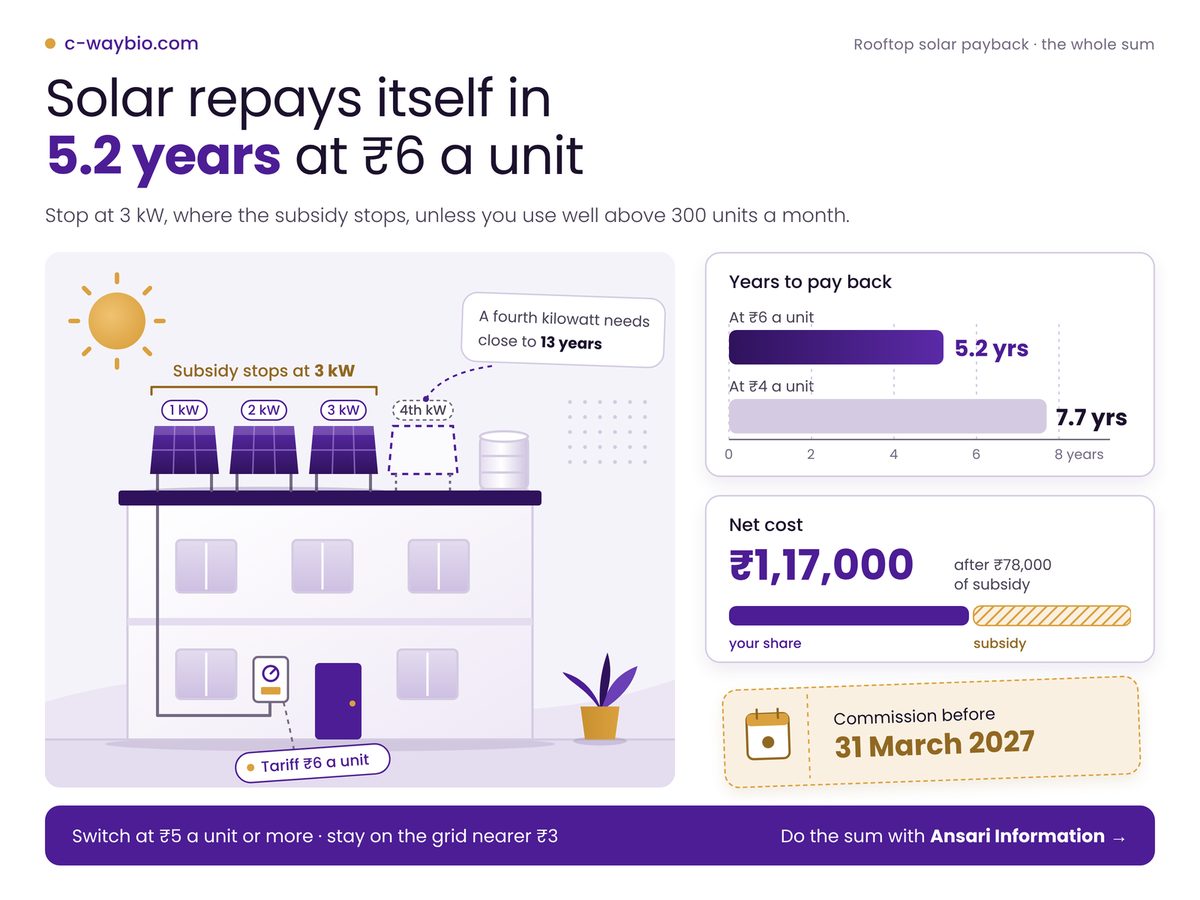
Key Takeaways: install 3 kW if your top slab costs ₹5 a unit or more and you use about 300 units a month; stay on the grid tariff if you pay nearer ₹3.
- The subsidy stops at 3 kW, so a fourth kilowatt takes about 13 years to earn back.
- Exported surplus is paid at the regulator's purchase cost, not your tariff.
- Commission before 31 March 2027, when the scheme's approved term ends.
- At ₹6 a unit, the scheme loan's instalment is smaller than the saving.
Why does the rooftop solar payback hinge on your tariff?
Because the subsidy and the panels' output are both fixed for a given size, the only large variable left is what each unit you stop buying is worth, and that is the slab tariff on your own bill.
The subsidy is a set rupee sum. The government's PM Surya Ghar page on india.gov.in (checked 29 October 2026) pays ₹30,000 a kilowatt for the first two and caps support at 3 kW, leaving ₹18,000 for the third. Every kilowatt past three costs full price, so the advice to fill the roof while the subsidy lasts is backwards.
Output is fixed too. BSES Delhi's Rooftop Solar FAQ (September 2025) puts each kilowatt at 3 to 4 units a day, and nothing under cloud cover, so 3 kW roughly matches a 300-unit home. It's the units-first logic we used to price an AC by kWh, not its star label.
Two dates sit on top of the sum. The scheme runs till FY 2026-27, so a system commissioned after 31 March 2027 may get nothing; our read is not to plan around an extension nobody has announced. Its collateral-free loan costs repo plus 50 basis points: 5.75% when MNRE minister of state Shripad Naik replied in the Rajya Sabha, as SolarQuarter reported on 29 July 2026. The RBI lifted repo to 5.50% on 7 October 2026, adding about ₹15 a month to a ten-year instalment (we ran the same hike against a home loan prepayment versus a SIP). Four numbers carry the decision.
Days Left in the Scheme
153 days
After that, the subsidy may lapse
Units per kW a Month
100 to 120
Size the system to your bill
Scheme Loan Rate Now
6.00% a year
Derived; sets your monthly instalment
EMI on Net 3 kW Cost
₹1,299 a month
Derived; under the ₹1,860 monthly saving
So borrow the post-subsidy cost at the scheme rate and the instalment is smaller than the electricity you stop buying: the system pays its way from the first bill, once the subsidy lands.
When the instalment is smaller than the bill it replaces, payback stops being a wait and becomes a monthly surplus.
How many years does a 3 kW system take to pay back?
A 3 kW PM Surya Ghar system takes about five years to pay back for a 300-unit home at ₹6 a unit, closer to eight years at ₹4 and about four at ₹8.
Worked example: a 3 kW system on a home using 300 units a month at ₹6 a unit. Assumptions: BSES's estimate of about ₹65,000 a kilowatt, 3.5 units a kilowatt a day (the middle of its range) and surplus valued at an assumed ₹4 a unit. Gross cost is ₹1,95,000; less ₹78,000 of subsidy leaves ₹1,17,000. The panels make 315 units a month: 300 replace units worth ₹21,600 a year, and 15 exported are worth ₹720. That is ₹22,320 a year, and ₹1,17,000 divided by ₹22,320 is 5.2 years.
The grid runs that sum for a 300-unit home. Your one-minute check: take the top-slab rate from your last bill, find your size down the side and read across to years to break even.
| System size | At ₹4 | At ₹6 | At ₹8 |
|---|---|---|---|
| 2 kW | 6.9 yrs | 4.6 yrs | 3.5 yrs |
| 3 kW | 7.7 yrs | 5.2 yrs | 4.0 yrs |
| 4 kW | 9.0 yrs | 6.7 yrs | 5.3 yrs |
| 5 kW | 9.8 yrs | 7.6 yrs | 6.2 yrs |
The bold cell is the worked example. A 2 kW system pays back sooner but leaves 90 units a month on your bill. The third kilowatt, about ₹47,000 after its subsidy share, earns roughly ₹7,200 a year: about 6.5 years. The fourth gets no subsidy and exports nearly everything, so it needs close to 13 years.
The subsidy covers four squares in ten, so judge payback on the six you fund, not the sticker price. Derived from india.gov.in's subsidy amounts and BSES's per-kilowatt cost.
What happens to extra solar units under net metering?
Under Delhi's net-metering rules, extra units carry forward from month to month, and any surplus left at the year's end is paid at the regulator's average power purchase cost (APPC), not at your retail tariff.
BSES says Delhi's regulator sets APPC and may revise it yearly; your state may differ. That is the fourth-kilowatt problem: you sell wholesale and buy retail.
Headlines need the same care. A Rajya Sabha written reply, reported by SolarQuarter, counted 3,972,447 rooftop systems installed by 22 July 2026 and 1.89 million households reporting zero bills, but only in months when generation met most of their needs. Model twelve months of partial savings; the zero-bill figure is the wrong yardstick.
BSES gives panels 25 years and inverters 10 to 12, and subsidised systems typically carry a five-year system warranty, so later repairs are yours. On the worked example's terms, payback reaches ten years only near ₹3 a unit; below that, a new inverter arrives first. State money pulls the other way: Delhi adds ₹10,000 a kilowatt up to ₹30,000, cutting the example to about 3.9 years. If the cash would otherwise sit in a deposit, check the post-tax gap between an FD and a debt fund, as we did for the payback years on a mini split.
- Subsidy timing: carry the full cost until the subsidy lands.
- Oversized quotes: sized to your roof, not your bills.
- Monsoon months: output stops under cloud, so bills won't hit zero.
- Warranty gap: ask who pays for the inverter after the warranty.
Check each line against your last twelve bills
- Your top slab costs ₹5 a unit or more.
- Your average use sits between 250 and 350 units.
- The quote names commissioning before 31 March 2027.
- You can fund the full cost until the subsidy arrives.
Our call: switch if your top slab costs ₹5 a unit or more, and stop at 3 kW unless you use well above 300 units a month. Stay on the grid tariff nearer ₹3, because the inverter will need replacing before the panels pay you back. This is wrong if your state adds a top-up or pays more for exported units, so this week run your last twelve bills through the calculator above and check your DISCOM's subsidy status on the national PM Surya Ghar portal before asking for a quote.
How we checked this
We read the government's PM Surya Ghar scheme page (checked 29 October 2026) and BSES Delhi's Rooftop Solar FAQ of September 2025, plus the July 2026 Rajya Sabha reply on loans and installations as reported by SolarQuarter. The worked example assumes a 300-unit home, 3.5 units a kilowatt a day, ₹65,000 a kilowatt and surplus valued at ₹4. No system was installed or tested hands-on for this article. Last verified: 29 October 2026.
Edited by Ansari, reviewed after publication. Spotted something out of date? Tell us and we will correct it.
No comments:
Post a Comment
Note: Only a member of this blog may post a comment.