Two 1.5-ton splits sit side by side on the showroom floor. Same brand, same tonnage, same inverter compressor. One wears a 5-star label and costs several thousand rupees more than the other, which wears a 4-star label. The salesman will walk you toward the expensive one and talk about savings. What he will not tell you is that those two labels were printed under different rulebooks, and under the current one, they might describe the same machine.
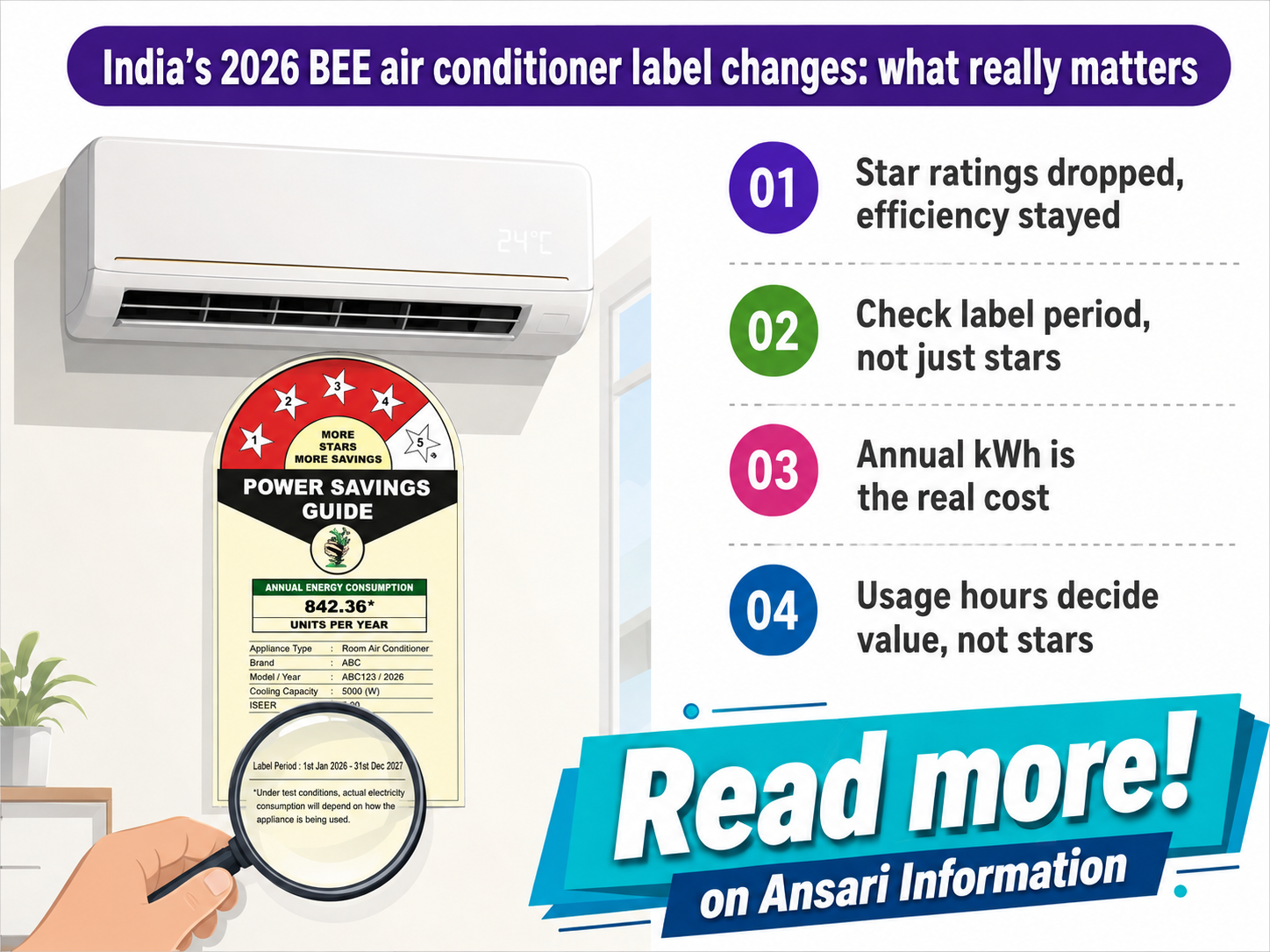
Why the star on the box stopped meaning anything
A BEE star is not an absolute grade. It is a rank against a threshold table, and the Bureau of Energy Efficiency moves that table upward every few years to keep pushing manufacturers. The 2026 revision moved it hard. Machines that cleared the top band under the previous table now land one rung lower, and every band below the top moved the same way. Nothing inside the box changed. The yardstick did.
Here is the part that trips people up: the sticker already printed and glued to a carton in a warehouse does not get reprinted. It keeps claiming whatever it claimed on the day it was issued. So the shelves right now carry a mix of genuine current-regime units and older stock still flashing a star count it would no longer earn. Both are legal. Both are on display. Only one of them is telling you the truth about where it sits in the 2026 pecking order.
And the price signal has been scrambled from the other direction too. The GST Council's 56th meeting cut the rate on air conditioners from 28% to 18% with effect from 22 September 2025, which should have made every AC in the country visibly cheaper. Then the efficiency changeover landed on top of it and pushed new-regime units back up. Blue Star's managing director put the gap on the incoming 5-star products at around 10%. If that pattern feels familiar, it should: it is the same thing that happened when the GST exemption on health insurance failed to lower renewal premiums. A tax cut and a cost increase arriving together look, on the price tag, like nothing happened at all.
Which brings us to the number that actually decides your bill. Every BEE label carries an annual power consumption figure in kWh per year, calculated on a standard usage assumption. That figure, multiplied by your tariff, is your running cost. It does not slip when the table moves, it does not depend on which label period the sticker was printed in, and it is directly comparable between any two units on the floor. GlobalPetrolPrices puts India's average household rate at well under half the world average, though your own slab position and the surcharges layered on top will push your effective rate above any national figure. The arithmetic is the same one worth running before committing to a home broadband connection: monthly outflow beats headline price every time.
Average Household Tariff
₹6.47/kWh
GlobalPetrolPrices, June 2025
Changeover Cost Increase
5% to 7%
Godrej, on air conditioners
Peak Load Per 1°C
7 GW
IEA, India, 2024
Efficiency Deadline
2030
Before per-degree load worsens
That peak-load figure is the reason the rulebook keeps tightening, and it is worth sitting with for a second. The IEA's reading is that a single degree of extra outdoor heat now drags a chunk of national generating capacity into service purely to run compressors, and that the number gets worse on current efficiency trends. Every star band that moves up is the regulator trying to bend that curve using the only lever it has, which is what you are allowed to sell. Your household bill is a side effect of that policy, not the target of it.
Five to seven percent added to the price of a machine, by the industry's own admission, to buy back a star that the rulebook took away for free. That is the trade.
Old-label stock versus a current-regime unit
The clearance window after peak summer is exactly when the older cartons come out at a discount, so this is not a hypothetical choice. It is what the floor looks like in September. The table below sets the two options against each other on the dimensions that decide the money, rather than the ones printed largest on the box.
| Dimension | Old-label clearance unit | Current-regime unit |
|---|---|---|
| Printed stars | Flatters the machine | Honest under today's table |
| Label period | Older block, printed pre-reset | Current block, issued after reset |
| Sticker price | Discounted to clear | Carries the changeover premium |
| Annual kWh | Printed and still valid | Printed and typically lower |
| Comparability | Stars mislead across regimes | Stars line up with rivals |
| Stock age | Warehoused a season or more | Fresh production run |
| Resale story | Buyer will discount the label | Holds its stated rating longer |
| Payback logic | Wins on short usage hours | Wins on heavy daily use |
| Best suited for | Guest rooms, second ACs, light seasonal use | Bedrooms run nightly through a long summer |
Read that bottom row carefully, because it is where the conventional advice breaks. "Always buy the highest star rating you can afford" was decent guidance when the table was stable. It is wrong roughly half the time now. An AC that runs four hours a night for three months cannot save enough electricity to repay that premium inside its useful life. An AC running ten hours a night from March to October repays it easily. Usage hours decide this, not the sticker.
The mapping below is the whole reset in one picture. Find where your candidate unit's printed star count sits on the left, and read across to what it is actually worth under the current table.
Every printed star count on an older label drops exactly one rung when re-scored against the current threshold table, which is why a pre-reset 2-star unit is now bottom of the pile.
Where this goes wrong at the counter
Dealers are not required to tell you which regime a label was issued under, and most floor staff genuinely do not know. The label period is printed at the bottom of the BEE sticker in small type. That is the single field worth photographing before you agree to anything, and it takes seconds. If the salesman cannot explain what the block of years at the bottom of his own sticker means, you are the better informed party in that conversation, which is roughly the same position you end up in when choosing between an authorised service centre and a local mechanic.
The other trap is the finance desk. A pricier machine on a no-cost EMI feels painless, and that is the point of the structure. But you are locking in the premium at the moment your information is worst, before you have run the kWh maths for your own usage hours. This is the same failure mode as buying a phone in launch week, which is what makes the timing question on smartphone upgrades worth reading alongside this one. Well, with one difference: a phone gets cheaper if you wait, whereas AC prices climb into March.
- Photograph the BEE label in full, including the label period line at the bottom, before any price discussion starts.
- Write down the annual power consumption in kWh per year for every unit on your shortlist and compare those numbers directly.
- Multiply that figure by your own effective tariff, not the state's headline slab rate, since fixed charges, duty and fuel surcharge all land on top.
- Ask whether the model is a current production run or warehouse stock, and get the answer in writing on the invoice.
- Treat any discount smaller than the running-cost gap over five years as no discount at all.
Four checks that survive any rulebook change
- Label period first, stars second. The years printed at the bottom of the sticker date the claim above it.
- kWh per year is regime-proof. It measures the machine, not its rank against other machines.
- Your tariff, not the average one. Slab position changes the answer more than the star count does.
- Hours of use decide the premium. Light seasonal use rarely earns back a higher-efficiency price.
Whether the reset actually changes what people buy, or just re-prices the same compressors under new stickers, is an open argument in the industry and nobody has a clean answer yet. The likelier read is that it mostly re-prices, at least for this cycle. Either way, your move is the same. Walk in with your effective tariff per unit already known, then compare kWh figures and ignore the stars entirely.
No comments:
Post a Comment
Note: Only a member of this blog may post a comment.